¶ Overview
Hyde-Smith repeatedly opposed the Affordable Care Act premium subsidies and dismissed Mississippians who faced increased healthcare costs.
200,000 Mississippi residents were originally projected to drop their insurance without the Affordable Care Act premium subsidies and health insurance costs in Mississippi increased by 41%. Mississippi's Insurance Commissioner confirmed that over 200,000 Mississippians left the ACA as of August 2026.
Hyde-Smith supported the GOP’s Big Beautiful Bill; the Senator praised the damaging legislation and downplayed the Medicaid cuts contained therein.
Six rural Mississippi hospitals were at risk of closure from the Big Beautiful Bill’s Medicaid cuts and Mississippi hospitals were projected to lose $1 billion. 115,000 Mississippians expected to lose their healthcare benefits under the Big Beautiful Bill and healthcare enrollment rates dropped by 8%.
Message: Hyde-Smith blocked Mississippians’ access to affordable healthcare and drove up their insurance costs.
¶ Hyde-Smith Opposed Access To Affordable Healthcare
¶ Hyde-Smith Opposed The Affordable Care Act Premium Subsidies And Inflated Mississippians’ Healthcare Costs
¶ Hyde-Smith Repeatedly Voted Against An Extension On The Premium Subsidies
2025: Hyde-Smith Effectively Voted Against Extending ACA Subsidies For Three Years. In December 2025, Hyde-Smith voted against, according to Congressional Quarterly, the “motion to invoke cloture on the Schumer motion to proceed to the bill that would provide for a three-year extension of the enhanced Affordable Care Act tax credits.” The vote was on cloture. The Senate rejected the motion by a vote of 51 to 48. [Senate Vote 644, 12/11/25; Congressional Quarterly, 12/11/25; Congressional Actions, S.3385]
- ACA Subsidies Were Set To Expire On December 31st With One-Third Of All Marketplace Enrollees Receiving Them. According to Congressional Quarterly, “That means the chamber won't vote on either bill as the Dec. 31 expiration nears for enhanced Affordable Care Act subsidies, which have been a focus of Congress for months. The enhanced tax credits were established (PL 117-2) in 2021 in response to the COVID-19 pandemic, and later extended through the end of this year (PL 117-169). As many as one-third of marketplace enrollees receive the enhanced level of subsidies. Without an extension, premium costs for those enrollees will rise significantly in 2026, with many saying they won't be able to afford coverage.” [Congressional Quarterly, 12/11/26]
2025: Hyde-Smith Effectively Voted For The Republican Proposal That Would Replace ACA Subsidies With HSA Contributions For Certain ACA Enrollees. In December 2025, Hyde-Smith voted for, according to Congressional Quarterly, the “motion to invoke cloture on the Barrasso motion to proceed to the bill. The bill would require the Health and Human Services Department to make contributions to the health savings accounts of certain individuals who are enrolled in bronze or catastrophic plans through an Affordable Care Act exchange and whose household income does not exceed 700 percent of the federal poverty line. For calendar years 2026 and 2027 it would provide $1,000 for enrollees between the ages of 18 to 49 and $1,500 for ages 50 to 64. It would also prohibit these funds from being used for abortion or gender affirming care. It would also impose citizenship and immigration verification requirements for Medicaid eligibility and ban Medicaid coverage of gender affirming care.” The vote was on cloture. The Senate rejected the motion by a vote of 51 to 48. [Senate Vote 643, 12/11/25; Congressional Quarterly, 12/11/25; Congressional Actions, S.3386]
2022: Hyde-Smith Voted Against Extending Tax Subsidies Toward Affordable Care Act Insurance Premiums For Eligible Individuals Through 2025. In August 2022, according to Congressional Quarterly, Hyde-Smith voted against the Inflation Reduction Act, which would “extend through 2025 tax subsidies toward Affordable Care Act marketplace insurance premiums for individuals under a certain income level.” The vote was on passage. The Senate passed the bill by a vote of 50-50, with Vice President Kamala Harris casting the tie-breaking vote in favor of the bill. The bill was sent to the House for final concurrence. The House concurred with the Senate, sent the bill to President Biden for signage, and the bill became law. [Senate Vote 325, 8/7/22; Congressional Quarterly, 8/7/22; Congressional Actions, S.Amdt. 5194; Congressional Actions, H.R. 5376]
¶ Hyde-Smith Mocked The Subsidies And Dismissed The Mississippians Who Relied On Them
Hyde-Smith Acknowledged That “Many Mississippians Rely On Obamacare And The Subsidies That Democrats Alone Passed To Prop Up The System” But Mocked The “Expensive COVID-Era Subsidies That Prop Up The Fraud-Plagued Affordable Care Act.” According to a press release from Senator Cindy Hyde-Smith, “Hyde-Smith (R-Miss.) today appealed for legitimate and serious negotiations to help Americans afford healthcare insurance without continuing expensive COVID-era subsidies that prop up the fraud-plagued Affordable Care Act, otherwise known the ACA or Obamacare. [...] ‘I know many Mississippians rely on Obamacare and the subsidies that Democrats alone passed to prop up the system, but we must do better. Escalating costs and growing evidence of fraud make the ACA unsupportable over the long term,’ Hyde-Smith added.” [Press Release – Senator Cindy Hyde-Smith, 12/11/25]
¶ Allowing The Subsidies To Expire Drove Up Costs For Mississippians And Stripped Away Their Access To Healthcare
¶ 200,000 Mississippi Residents Were Projected To Drop Their Insurance Without The Affordable Care Act Premium Subsidies And Health Insurance Costs In Mississippi Increased By 41%
200,000 Mississippi Residents Were Projected To Drop Their Insurance Without The Affordable Care Act Premium Subsidies. According to WLBT, “Affordable Care Act subsidies implemented in 2020 are set to expire January 1, leading to higher insurance premiums after Congress declined to extend the assistance. [...] Officials estimate up to 200,000 Mississippi residents could become uninsured due to the cost increases.” [WLBT, 12/26/25]
Health Insurance Costs In Mississippi Increased By 41% Without The ACA Premium Subsidies. According to WLBT, “Affordable Care Act subsidies implemented in 2020 are set to expire January 1, leading to higher insurance premiums after Congress declined to extend the assistance. [...] Mississippi Insurance Commissioner Mike Chaney said the average increase for ACA plans is about 41% in the state. ‘A family of four making $63,000 annually would pay about $275 monthly for a bronze plan and $325 for a silver plan under the new rates,’ Chaney estimates.” [WLBT, 12/26/25]
¶ Over 200,000 Mississippians Lost Their Healthcare Coverage Since December 2025
Over 200,000 Mississippians Lost Their Healthcare Coverage Since December 2025 Resulting In Less Than 125,000 People Left On The Affordable Care Act. According to WLBT, “More than 200,000 Mississippians have recently lost health coverage, according to Insurance Commissioner Mike Chaney. ‘We had 335,000 people on the Affordable Care Act at the end of December of 2025… and we’re down to 125,000 or less people,’ Chaney said.” [WLBT, 8/18/26]
Hospitals Warned That Patients Going Without Coverage Could Result In Conditions Worsening And Costs Increasing. According to WLBT, “The association said going without coverage can mean putting off care. ‘Ultimately, if patients go without care because they can’t afford to pay for it, their condition gets worse. And then when they finally do access the system, not only is their condition worse, the cost of treating that condition is going to be higher,’ the association said.” [WLBT, 8/18/26]
¶ Hyde-Smith Backed Medicaid Cuts Which Harmed Mississippians
¶ Hyde-Smith Voted For The Big Beautiful Bill
2025: Hyde-Smith Voted For The Senate FY 2025 Budget Reconciliation Bill That Extended $4 Trillion In Expiring Tax Cuts, Added New Tax Breaks, Appropriated $448 Billion In Defense, Border, And Immigration Enforcement Funding, Increased The SALT Deduction To $40,000, And Cut Medicaid And Other Social Programs To Offset The Costs. In July 2025, Hyde-Smith voted for, according to Congressional Quarterly, “the bill, as amended, that would permanently extend nearly $4 trillion in expiring individual and business tax cuts, create several new tax breaks and fund border and immigration enforcement and air traffic control upgrades. It would cut Medicaid and other safety net programs to partly offset the cost. Among other provisions, it would raise the statutory debt ceiling by $5 trillion and appropriate more than $448 billion in mandatory funding for Trump administration priorities and other needs, including $153 billion for defense, $89 billion for immigration enforcement, and $89.5 billion for border control and security. It also would increase the state and local tax deduction cap to $40,000 annually for five years for households making up to $500,000 a year until 2030, when it would permanently revert to $10,000.” The Senate passed the bill by a vote of 50 to 50 with Vice President Vance casting the tie-breaking vote. [Senate Vote 372, 7/1/25; Congressional Quarterly, 7/1/25; Congressional Actions, H.R. 1]
- The Bill Would Reduce Medicaid And Children’s Health Insurance Program Funding By $1 Trillion And Remove 10.5 Million People From The Programs By 2034. According to the Center For American Progress, “The nonpartisan Congressional Budget Office (CBO) estimated that the OBBBA will cut federal spending on Medicaid and Children’s Health Insurance Program (CHIP) benefits by $1.02 trillion, due in part to eliminating at least 10.5 million people from the programs by 2034.” [Center For American Progress, 7/3/25]
2025: Hyde-Smith Voted Against Striking Language Prohibiting Medicaid Payments For Home Or Community-Based Services From Being Used To Pay Employees’ Benefits. In July 2025, Hyde-Smith voted against, according to Congressional Quarterly, the “amendment no. 2817 to the Thune, R-S.D. for Graham, R-S.C., substitute amendment no. 2360 that would strike language prohibiting the use of Medicaid payments for expanded home or community-based services to pay employee benefits to practitioners of such services.” The vote was on the amendment. The underlying bill was the FY 2025 reconciliation bill. The Senate rejected the amendment by a vote of 48 to 52. [Senate Vote 361, 7/1/25; Congressional Quarterly, 7/1/25; Congressional Actions, S.Amdt. 2817; Congressional Actions, H.R. 1]
2025: Hyde-Smith Effectively Voted To Prohibit States From Receiving Medicaid And Children’s Health Insurance Program Funding Unless They Require Recipients To Prove Their Citizenship. In June 2025, Hyde-Smith voted for, according to Congressional Quarterly, the “motion to waive the Congressional Budget Act for the purpose of amendment no. 2401 to the Thune, R-S.D., for Graham, R-S.C., substitute amendment no. 2360 to the fiscal 2025 budget reconciliation bill (HR 1). The amendment would prohibit states from using federal funds under Medicaid or the Children's Health Insurance Plan to cover individuals who do not prove their citizenship or ‘satisfactory’ immigration status within a 90-day period.” The vote was on the motion to waive. The Senate rejected the motion by a vote of 53 to 47. [Senate Vote 345, 6/30/25; Congressional Quarterly, 6/30/25; Congressional Actions, H.R. 1]
2025: Hyde-Smith Effectively Voted Against Striking Medicaid Cuts To Labor And Delivery Units In The Reconciliation Bill. In June 2025, Hyde-Smith voted against, according to Congressional Quarterly, the “motion to commit the bill to the Senate Finance Committee with instructions on Medicaid and labor and delivery units and to report back to the Senate.” The vote was on the motion to commit. The Senate rejected the motion by a vote of 48 to 52. [Senate Vote 340, 6/30/25; Congressional Quarterly, 6/30/25; Congressional Actions, H.R. 1]
2025: Hyde-Smith Voted Against Striking Medicaid Cuts In The Reconciliation Bill That Could Lead To Nursing Home Closures. In June 2025, Hyde-Smith voted against, according to Congressional Quarterly, the “motion to commit the fiscal 2025 budget reconciliation bill (HR 1) to the Senate Finance Committee with instructions on the Supplemental Nutrition Assistance Program and report back to the Senate.” The vote was on the motion to commit. The Senate rejected the motion by a vote of 48 to 52. [Senate Vote 338, 6/30/25; Congressional Quarterly, 6/30/25; Congressional Actions, H.R. 1]
2025: Hyde-Smith Effectively Voted Against Striking Medicaid Cuts From The Reconciliation Bill. In June 2025, Hyde-Smith voted against, according to Congressional Quarterly, the “motion to commit the bill to the Senate Finance Committee with instructions to strike all Medicaid cuts from the bill and report it back to the Senate.” The vote was on the motion to commit. The Senate rejected the motion by a vote of 47 to 53. [Senate Vote 335, 6/30/25; Congressional Quarterly, 6/30/25; Congressional Actions, H.R. 1]
2025: Hyde-Smith Effectively Voted Against Prohibiting Provisions In The Reconciliation Bill From Increasing The Likelihood Of Rural Hospitals To Close. In June 2025, Hyde-Smith voted against, according to Congressional Quarterly, “motion to commit the bill to the Senate Finance Committee with instructions to report the bill back to the Senate in three days with changes that would would strike any provision that would result in increased likelihood of rural hospitals being forced to close, convert, or reduce or stop providing services.” The vote was on the motion to commit. The Senate rejected the motion by a vote of 49 to 51. [Senate Vote 333, 6/30/25; Congressional Quarterly, 6/30/25; Congressional Actions, H.R. 1]
2025: Hyde-Smith Voted Against Committing The Reconciliation Bill To The Finance Committee With Instructions To Reduce Health Care Costs For American Families. In June 2025, Hyde-Smith voted against, according to Congressional Quarterly, “motion to commit the bill to the Senate Finance Committee with instructions to report the bill back to the Senate in three days with changes that would ‘reduce the cost of health care for American families and small businesses while ensuring the wealthy and big corporations pay their fair share.’” The Senate rejected the motion by a vote of 47 to 53. [Senate Vote 332, 6/30/25; Congressional Quarterly, 6/30/25; Congressional Actions, H.R. 1]
¶ Hyde-Smith Praised The Big Beautiful Bill And Downplayed The GOP’s Medicaid Cuts
Hyde-Smith Claimed Republicans Were “Improving And Preserving Medicaid For Those Who Need It” And Protecting Rural Healthcare. According to a press release from Senator Cindy Hyde-Smith, “Republicans are improving and preserving Medicaid for those who need it while enacting specific checks to root out waste, fraud, and abuse. These reforms will help ensure the program’s integrity so it remains available to those who rely on these crucial benefits. [...] The Working Families Tax Cut Act includes $50 billion for a Rural Health Care Transformation Fund to ensure hospitals, nursing homes, community health centers, and other rural providers can continue serving their communities and improve care. ” [Press Release – Senator Cindy Hyde-Smith, 7/26/25]
Hyde-Smith Said Medicaid Spending Was “Projected To Grow By Billions Of Dollars Over The Next 10 Years” And Claimed That “Only In Washington Is A Smaller Increase In Funding Considered A Cut.” According to a press release from Senator Cindy Hyde-Smith, “Even with these reforms, spending on Medicaid is projected to grow by billions of dollars over the next 10 years. Only in Washington is a smaller increase in funding considered a cut.” [Press Release – Senator Cindy Hyde-Smith, 7/26/25]
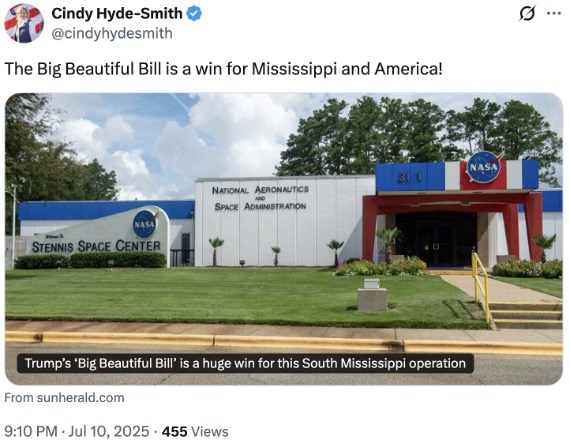
Hyde-Smith Claimed The Big Beautiful Bill Was “A Win For Mississippi.” Senator Cindy Hyde-Smith tweeted, “The Big Beautiful Bill is a win for Mississippi and America!” [Twitter, @cindyhydesmith, 7/10/25]
¶ The Big Beautiful Harmed Mississippi And Slashed Mississippians’ Healthcare
¶ Six Rural Mississippi Hospitals Were At Risk Of Closure From The Big Beautiful Bill’s Medicaid Cuts And Rural Hospitals Across The State Faced A Funding Crisis
Six Rural Mississippi Hospitals Were At High Risk “Of Closing, Reducing The Medical Services They Provide, Or Laying Off Workers” From The Big Beautiful Bill’s Medicaid Cuts. According to the Clarion Ledger, “Six Mississippi hospitals could have to close or reduce services if they take hard hits after Medicaid funding cuts. A new report broke down affects of the One Big, Beautiful Bill on hospitals nationwide. It's expected to cut $911 billion in spending on Medicaid and CHIP (the federal insurance program for kids). Millions could lose health coverage after change to eligibility and work requirements. [...] Public Citizen noted six Mississippi hospitals that have a high risk ‘of closing, reducing the medical services they provide, or laying off workers.’” [Clarion Ledger, 4/14/26]
Rural Hospitals In Mississippi Faced A Funding Crisis With The Big Beautiful Bill’s Funding Cuts. According to Mississippi Today, “The program was designed to reduce the disproportionate impact already-struggling rural hospitals are expected to bear as a result of last summer’s federal spending cuts. But this fund alone will not replace the cuts to rural hospitals, Alker said. ‘It’s not enough money, and it’s not designed to replace it,’ she said. ‘…This is not going to address the crisis that many rural hospitals are facing.’” [Mississippi Today, 4/21/26]
Hospitals In Mississippi Were Projected To Lose $1 Billion Over The Next Decade Under The Bid Beautiful Bill. According to Mississippi Today, “Hospitals in Mississippi — already strained under the costs of caring for a high rate of patients without health insurance and with low-reimbursement plans, such as Medicaid — are expected to lose $1 billion over the course of the next decade as a result of President Donald Trump’s sweeping tax and spending bill signed into law in July.” [Mississippi Today, 4/21/26]
¶ 115,000 Mississippians Were Projected To Lose Their Medicaid Benefits Under The Big Beautiful Bill And Healthcare Enrollment Rates Were Down 8% In Mississippi
115,000 Mississippians Were Projected To Lose Their Medicaid Benefits Under The Big Beautiful Bill. According to the Mississippi Free Press, “About 115,000 Mississippians could lose Medicaid benefits under the bill, the Center for American Policy predicts. The Center on Budget and Policy Priorities estimates that between 9.9 million and 14.9 million Americans could be at risk of losing Medicaid coverage by 2034 due to H.R. 1.” [Mississippi Free Press, 1/16/26]
Healthcare Enrollment Rates Were Down 8% In Mississippi Under The Big Beautiful Bill. According to Mississippi Today, “In January, early enrollment data showed Marketplace enrollments were down about 8% — a figure that experts expected to fall further, because people may drop coverage after receiving their first bill reflecting a higher monthly premium.” [Mississippi Today, 4/21/26]