¶ Overview
- Allen voted for a bill that would kick 17 million Americans off their health insurance, including nearly 12 million Americans off of Medicaid. More than 40,000 Georgians could lose their health coverage as a result of his votes. 45 health care facilities across Georgia were at risk of closing or significantly reducing services due to the Medicaid cuts, including a rural hospital in Allen’s district.
- Allen had a long history of trying to repeal the Affordable Care Act. Since 2015, he has promised to fight to repeal the law that helped more than 1.5 million Georgians get health insurance. During his time in congress, he has voted time and time again to repeal the law and voiced staunch opposition to both expanding and extending premium tax credits that help Georgians afford health insurance. Most recently, he ardently opposed an extension of critical health care tax credits – voting three times against it – and Georgians saw their premiums spike as a result.
¶ Allen Voted To Take Health Care From Georgians
¶ allen voted to take health care from 17 million americans
¶ July 2025: Allen Voted For The Final Version Of Republicans’ Reconciliation Bill
7/3/25: Allen Voted For The Senate FY 2025 Budget Reconciliation Bill That Cut Medicaid And Other Social Programs To Offset The Bill’s Costs. In July 2025, Allen voted for, according to Congressional Quarterly, the “motion to concur in the Senate amendment to the bill that would permanently extend nearly $4 trillion in expiring individual and business tax cuts, create several new tax breaks and fund border and immigration enforcement and air traffic control upgrades. It would cut Medicaid and other safety net programs to partly offset the cost. Among other provisions, it would raise the statutory debt ceiling by $5 trillion and appropriate more than $448 billion in mandatory funding for Trump administration priorities and other needs, including $153 billion for defense, $89 billion for immigration enforcement, and $89.5 billion for border control and security. It also would increase the state and local tax deduction cap to $40,000 annually for five years for households making up to $500,000 a year until 2030, when it would permanently revert to $10,000.” The House passed the bill by a vote of 218 to 214. [House Vote 190, 7/3/25; Congressional Quarterly, 7/3/25; Congressional Actions, H.R. 1]
- HEADLINE: "At Least 17 Million Americans Would Lose Insurance Under Trump Plan" [Washington Post, 7/1/25]
- The Congressional Budget Office Estimated That 11.8 Million People Would Become Uninsured As A Result Of The Medicaid Cuts In Republicans’ Reconciliation Bill. According to the Washington Post, "The bill, which narrowly passed the Senate on Tuesday and now heads back to the House, would effectively accomplish what Republicans have long failed to do: unwind many of the key components of the ACA, President Barack Obama’s signature domestic achievement, which dramatically increased the number of Americans with access to health insurance. To start, the Congressional Budget Office estimated that the Senate version of the bill would result in 11.8 million more uninsured in 2034, mostly because of Medicaid cuts, compared with 10.9 million if the House version became law." [Washington Post, 7/1/25]
¶ May 2025: Allen Voted For House Republicans’ Budget Bill, Which Would Kick Millions Of People Off Medicaid
5/22/25: Allen Voted For The FY 2025 Budget Reconciliation Bill That Included $3.8 Trillion In Tax Cuts Offset By $1.5 Trillion In Spending Reductions To Programs Like Medicaid And The Supplemental Nutrition Assistance Program. In May 2025, Allen voted for, according to Congressional Quarterly, “the bill that would provide for approximately $3.8 trillion in net tax cuts and $321 billion in military, border enforcement and judiciary spending, offset by $1.5 trillion in spending reductions, as instructed in the fiscal 2025 budget resolution (H Con Res 14). It would raise the statutory debt limit by $4 trillion and provide for increased spending on defense and border security, spending cuts on social safety net programs, such as Medicaid and the Supplemental Nutrition Assistance Program. It also includes a mix of tax breaks for businesses and individuals; tax increases on universities and foundations; and a phase-down of clean energy tax credits. […] It would reduce federal spending on the Supplemental Nutrition Assistance Program by requiring states to shoulder more of the cost, expand work requirements for SNAP, extend programs authorized under the 2018 farm bill, and prohibit the U.S. Department of Agriculture from increasing the cost of the Thrifty Food Program. As amended, it would cap state and local tax deductions at $40,000 for households with incomes below $500,000.” The House passed the bill by a vote of 215 to 214. [House Vote 145, 5/22/25; Congressional Quarterly, 5/22/25; Congressional Actions, H.R. 1]
- The House GOP Budget Bill Was Estimated To Increase The Uninsured Population By 8.6 Million By 2034. According to CNN, “The Medicaid and Affordable Care Act provisions in the package could result in 8.6 million more people being uninsured in 2034, according to an early CBO estimate released by Democratic lawmakers. That number is expected to grow with the latest changes.” [CNN, 5/28/25]
- The House GOP Budget Bill Codified A Trump Administration Proposal That Restricted Access To The Affordable Care Act. According to CNN, “The bill also calls for codifying a Trump administration proposal that would make changes to the Affordable Care Act enrollment process, including shortening the open enrollment period and eliminating the ability of low-income Americans to sign up year-round.” [CNN, 5/28/25]
¶ February 2025: Allen Voted For A Budget Resolution That Spelled Out Future Medicaid Cuts But He Claimed It Didn’t
2/25/25: Allen Voted For The FY 2025 Budget Framework That Included $2 Trillion In Cuts, Raised The Statutory Debt Limit By $4 Trillion, And Required House Committees To Recommend Legislation That Would Implement Trump’s Agenda. In February 2025, Allen voted for, according to Congressional Quarterly, “the concurrent resolution that would recommend a budget for fiscal 2025 and budget levels through fiscal 2034. The resolution would assume minimum savings of $1.5 trillion over 10 years and 2.6 percent economic growth over the same period. It also would require the statutory debt limit to be raised by $4 trillion. It also would authorize the House Ways and Means Committee to increase deficits by $4.5 trillion over 10 years to extend the 2017 tax cuts and implement new tax cuts proposed by the White House. It also would provide instructions for the budget reconciliation process through which separate legislation could be considered and passed in the Senate via a simple majority vote. The measure would deliver instructions to 11 House committees to report legislation that would implement President Donald Trump’s agenda, such as expanding tax cuts and bolstering border security and immigration enforcement. The committees would be required to report their legislative recommendations to the House Budget Committee by March 27, 2025. It also would set a $2 trillion target for the spending cuts to be submitted to the House Budget Committee. The resolution also would stipulate that if the committees don't reach that target, the Ways and Means’ reconciliation instructions to increase the deficit by a maximum of $4.5 trillion would be decreased by the amount the other committees come in below the target. Similarly, it would stipulate that Ways and Means could increase the deficit above the $4.5 trillion level by the amount of savings the committees achieve above the $2 trillion target.” The vote was on passage. The House passed the resolution by a vote of 217 to 215. [House Vote 50, 2/25/25; Congressional Quarterly, 2/25/25; Congressional Actions, H. Con. Res. 14]
- HEADLINE: “What Can House Republicans Cut Instead Of Medicaid? Not Much.” [New York Times, 2/25/25]
- HEADLINE: "House Republican Budget Takes Away Health Care, Food Aid To Pay For Expanded Tax Cuts For Wealthy" [Center on Budget and Policy Priorities, 2/21/25]
- New York Times Reported The $880 Billion In Cuts Required By The Republican Budget Proposal Would Have To Come From Medicaid, Medicare, Or CHIP. According to the New York Times, "The budget resolution itself is silent on whether Congress cuts Medicaid, which provides health coverage to 72 million poor and disabled Americans. But it instructs the House Energy and Commerce Committee, which has jurisdiction over the program, to cut spending by $880 billion over the next decade. If the committee can’t save at least that much, the entire effort could be imperiled because of the special process Congress is using to avoid a Senate filibuster. Ten other committees have their own instructions to follow, though none have been assigned with cutting nearly as much. It’s not so simple as finding the cuts elsewhere. The special process, known as budget reconciliation, means Republicans will have to find all $880 billion from within the Energy and Commerce Committee’s jurisdiction. That leaves them with fewer options than one might think. […] If Republicans want to avoid major cuts to Medicaid, the largest pot of available money is in the other big government health insurance program: Medicare. […] Even if the committee cuts everything that’s not health care to $0, it will still be more than $600 billion short. The committee could also save around $200 billion by eliminating the Children’s Health Insurance Program, but that option has not been raised by the budget committee or anyone in House leadership. […] Even if all of these cuts, revenues and rule cancellations from outside health care can pass muster, the committee will still be left with hundreds of billions of dollars to cut to hit its goal. Mathematically, the budget committee’s instructions mean the committee would need to make major cuts to either Medicare, Medicaid or both." [New York Times, 2/25/25]
¶ allen FIERCELY defended the republican budget bill, claiming it was “blatant misinformation peddling” that people would lose their health care
August 2025: Allen Defended The Republican Budget Bill And Called Claims That The Legislation Would Kick People Off Health Care “Blatant Misinformation Peddling.” According to an opinion by Rep. Rick Allen published in the Statesboro Herald, “Claims that Congress has kicked millions of people off their healthcare is blatant misinformation peddling. Don't fall for this. If you think there isn't waste, fraud and abuse in Medicaid — you need to check your sources. Some will say this doesn't exist, but from 2018-2023, annual Medicaid spending ballooned at twice the rate of inflation. Why? Keep reading. The Congressional Budget Office (CBO) estimates there are 4.8 million able-bodied adults on Medicaid who choose not to work, 1.6 million duplicative and deceased enrollees that will be removed from the Medicaid rolls under the OBBB, and 1.3 million people who are ineligible for Medicaid, but states are unable to remove them from the rolls due to burdensome Biden-Harris era restrictions. Additionally, CBO has confirmed that, overall, states will save money from the elimination of wasteful mandates, which means more money will be available to reinvest in our traditional Medicaid population.” [Rep. Rick Allen Opinion – Statesboro Herald, 8/1/25]
- Allen Claimed The Republican Budget Bill Eliminated “Waste, Fraud And Abuse” In Medicaid And Provided A Boost To Rural Hospitals. According to an opinion by Rep. Rick Allen published in the Statesboro Herald, “In strengthening the integrity of Medicaid by eliminating waste, fraud and abuse, its resources can be refocused on providing better care for those whom the program was designed to serve: pregnant women, children, people with disabilities, low-income seniors and other vulnerable low-income families. This is common sense. Regarding rural hospitals, they comprise just 7% of all hospital spending on Medicaid, illustrating that they have not benefited from the massive increase in waste, fraud and abuse under the Biden Administration. The OBBB provides a record $50 billion in new funding going to rural hospitals, while also eliminating financing loopholes that risked the long-term sustainability of the Medicaid program. For years, states and providers have relied on tactics like provider taxes and state directed payments to draw down excessive federal funds to pay for other non-Medicaid state expenses. President Biden allowed these abuses to explode over the last four years, setting Medicaid on an unsustainable path. The OBBB fixes these abuses.” [Rep. Rick Allen Opinion – Statesboro Herald, 8/1/25]
¶ More Than 40,000 Georgians In The 12th Congressional District Could Lose Health Coverage A Result Of Allen’s Votes
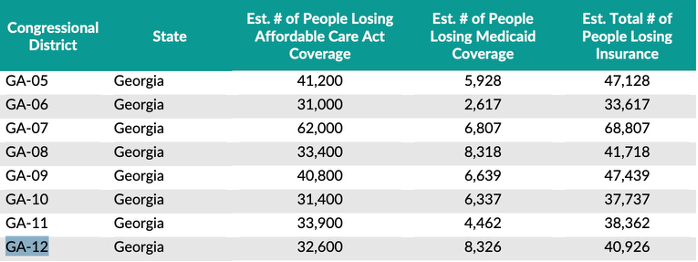
An Estimated 40,926 People In Allen’s District On The Affordable Care Act And Medicaid Were Set To Lose Coverage Due To Republican Budget Bill Health Care Cuts. According to the Joint Economic Committee,
[Joint Economic Committee, Viewed 12/3/25]
2023: 183,600 Georgians In The 12th Congressional District Were Enrolled In Medicaid Or CHIP. According to the Center for American Progress,

[Center for American Progress, 3/11/25]
¶ 45 health care facilities in georgia, including one rural hospitals in allen’s district were at risk of closing or reducing services because of the republican budget bill
45 Health Care Facilities Across Georgia Were At Risk Of Closing Or Significantly Reducing Services Due To The Republican Spending Bill Cuts. According to the Georgia Recorder, “A Georgia Recorder analysis found that 45 health care facilities across 35 Georgia counties risk reducing services or closing altogether due to the bill’s spending cuts. Those facilities include hospitals, nursing homes and Planned Parenthood centers across both urban and rural parts of the state, all of which will likely face funding gaps under the budget reconciliation bill.” [Georgia Recorder, 7/14/25]
The Washington County Regional Medical Center In Allen’s County Was Deemed One Of Four Rural Georgia Hospitals Most At Risk Of Closure Due To The Republican Budget Bill Cuts. According to the Georgia Recorder, “Hospitals in rural parts of the state, many of which rely on funding from Medicaid to sustain their facilities, may be among the hardest hit health care providers under the new bill. That includes four hospitals in rural Georgia: Fannin Regional Hospital in Blue Ridge, Flint River Community Hospital in Montezuma, Irwin County Hospital in Ocilla and Washington County Regional Medical Center in Sandersville. Three of those hospitals are in counties represented by Republican congressmen who voted in favor of the bill, and all four border at least one county that lacks its own hospital.” [Georgia Recorder, 7/14/25]
September 2025: A Hospital In Georgia Ended Services For Delivering Mothers And Newborn Babies Due To The Medicaid Cuts In The Republican Budget Bill. According to a press release from Sen. Jon Ossoff, “St. Mary’s Sacred Heart Hospital in Northeast Georgia is ending services for delivering mothers and newborn babies due to Medicaid cuts in Trump’s budget law. Last week, St. Mary’s Health Care System announced that St. Mary’s Sacred Heart Hospital in Lavonia will close its labor and delivery unit next monthThis is an external link, consolidating maternity services at its main hospital in Athens nearly an hour away due in part to Medicaid cuts in the Trump budget law. The hospital system also said St. Mary’s Medical Group will discontinue care at Clear Creek OB/GYNThis is an external link in Lavonia.” [Press Release – Sen. Jon Ossoff, 9/15/25]
¶ Allen Has Voted To Repeal The Affordable Care Act Many Times And Opposed Extending Tax Credits That Helped Georgians Afford Health Insurance
¶ since 2015, allen has promised to fight to repeal the affordable care act
January 2015: Allen Promised To “Fight To Repeal ObamaCare” And Cosponsored The “ObamaCare Repeal Act.” According to a press release from Rep. Rick Allen, “As part of his continued efforts to repeal and replace ObamaCare, Congressman Allen is cosponsoring H.R. 132, the ObamaCare Repeal Act, introduced by Rep. Steve King (R-IA-4).’I promised my constituents I would fight to repeal ObamaCare, and I’m proud to cosponsor legislation to provide Americans relief from this unaffordable and unworkable law,’ said Allen. ’Higher health care costs and fewer care options resulting from ObamaCare continue to hurt hardworking families. Business owners have been forced to cut back on hiring and lower the hours and wages of employees because of the law’s costly mandates. ObamaCare is a law that is broken beyond repair, and I look forward to continuing the fight with my colleagues to repeal and replace it with what the American people deserve – real reforms that lower health care costs and expand access.’” [Press Release – Rep. Rick Allen, 1/28/15]
- 2015: Allen Touted His Vote To Repeal The Affordable Care Act. According to a post on Rick Allen’s Facebook, “Obamacare is not a good prescription for Georgia! Yesterday I voted for a full repeal of Obamacare fulfilling my promise to Georgia. Share if you agree that Obamacare is bad medicine!” [Facebook, Rick Allen, 2/4/15]
¶ allen has repeatedly voted to repeal the affordable care act
4/3/19: Allen Voted Against Condemning The Trump Administration For Pushing Legal Action To Attack The Affordable Care Act. According to the Clerk of the U.S. House of Representatives, Allen voted against, "This resolution urges the Department of Justice (DOJ) to cease its efforts against the Patient Protection and Affordable Care Act (PPACA) and reverse its position in Texas v. United States. (On March 25, 2019, DOJ submitted a letter to the appellate court agreeing with the lower court's decision that PPACA should be struck in its entirety)." [U.S. House of Representatives, H.R. 271, Vote 146, 4/3/19]
- HEADLINE: "House Condemns Trump Administration For Legal Attack On Health Law" [New York Times, 4/3/19]
2019: Allen Voted Against Directing The Office Of The General Counsel Of The House To Represent The House In The Texas ACA Case Which Sought To Overturn The Entire ACA. In January 2019, Allen voted against rules for the 116th Congress. According to Congressional Quarterly, “Adoption of the resolution that would establish the rules of the House for the 116th Congress. Title III of the resolution would authorize the speaker, on behalf of the House of Representatives, to intervene in the Texas court case that found the 2010 healthcare law unconstitutional and other cases related to the law. It would also direct the Office of General Counsel to represent the House in any such litigation.” The House passed the resolution by a vote of 235 to 192. [House Vote 19, 1/9/19; Congressional Quarterly, 1/9/19; Congressional Actions, H. Res. 6]
- House Democrats Sought To Allow The Speaker And The House To Intervene In A Court Case Where A Texas Judge Had Ruled The Affordable Care Act Was Unconstitutional. According to the Washington Post, "House Democrats used their new majority on Thursday to squeeze Republicans on health care, taking the first step to intervene in a court case in which a Texas judge has ruled the Affordable Care Act unconstitutional. That move will be followed by a vote next week designed to force GOP lawmakers into a political corner: agree to defend a law many members have spent years reviling or appear to oppose popular ACA protections for millions of Americans with preexisting medical conditions that many have pledged to uphold. […] Thursday’s authorization was part of a collection of rules the House adopted to guide its operation in the new Congress. It gives Pelosi permission to intervene in the Texas court case and allows the chamber’s counsel to work on the litigation." [Washington Post, 1/3/19]
2017: Allen Voted For The FY 2018 Republican Study Committee Budget Resolution Which In Part Called For Fully Repealing Obamacare. In October 2017, Allen voted for a budget resolution that would in part, according to Congressional Quarterly, “provide for $2.9 trillion in new budget authority in fiscal 2018. It would balance the budget by fiscal 2023 by reducing spending by $10.1 trillion over 10 years. It would cap total discretionary spending at $1.06 trillion for fiscal 2018 and would assume no separate Overseas Contingency Operations funding for fiscal 2018 or subsequent years and would incorporate funding related to war or terror into the base defense account. It would assume repeal of the 2010 health care overhaul and would convert Medicaid and the Children’s Health Insurance Program into a single block grant program. It would require that off budget programs, such as Social Security, the U.S. Postal Service, and Fannie Mae and Freddie Mac, be included in the budget.” The underlying legislation was an FY 2018 House GOP budget resolution. The House rejected the RSC budget by a vote of 139 to 281. [House Vote 555, 10/5/17; Congressional Quarterly, 10/5/17; Congressional Actions, H. Amdt. 455; Congressional Actions, H. Con. Res. 71]
- Legislation Called For Repealing The ACA And Replacing It With Parts Of AHCA. According to the Republican Study Committee FY 2018 Budget, “Obamacare is a failed experiment and cannot be reformed; it must be fully repealed. […] The RSC budget fully repeals Obamacare and its distortionary and destructive tax increases. […] On January 4, 2017, the RSC reintroduced the American Health Care Reform Act (AHCRA), the updated version of the patient-centered health care reform legislation that the RSC has sponsored since the 113th Congress. Introducing AHCRA on the second day of the 115th Congress kick-started a process by which the House has begun to fulfill the promise of repealing and replacing Obamacare. The American Health Care Act (AHCA) passed the House on May 4, 2017. This reconciliation bill, while not perfect by any standards, includes many of the principles and policies first put forward in legislation by the RSC.” [Republican Study Committee, Accessed 10/17/17]
2017: Allen Voted For The American Health Care Act That Which Would Result In 23 Million Fewer Americans With Health Insurance By 2026. In May 2017, Allen voted for the American Health Care Act which would have significantly repealed portions of the Affordable Care Act by cutting Medicaid, cutting taxes on the rich, removing safeguard for pre-existing conditions and defunding Planned Parenthood. The overall legislation would have in part, also according to Congressional Quarterly, “ma[d]e extensive changes to the 2010 health care overhaul law, by effectively repealing the individual and employer mandates as well as most of the taxes that finance the current system. It would [have], in 2020, convert[ed] Medicaid into a capped entitlement that would provide[d] fixed federal payments to states and end[ed] additional federal funding for the 2010 law’s joint federal-state Medicaid expansion. It would prohibit federal funding to any entity, such as Planned Parenthood, that performs abortions and receives more than $350 million a year in Medicaid funds. […] It would [have] allow[ed] states to receive waivers to exempt insurers from having to provide certain minimum benefits.” The vote was on passage. The House passed the bill by a vote of 217 to 213. The bill, in modified forms, died in the Senate. [House Vote 256, 5/4/17; Congressional Quarterly, 5/4/17; Kaiser Family Foundation, 5/17; Congressional Actions, H.R. 1628]
- HEADLINE: "The American Health Care Act: The Obamacare Repeal Bill The House Just Passed, Explained" [Vox, 5/4/17]
- The American Health Care Act Would Have Resulted In 14 Million Additional Uninsured Americans In 2018, Rising To 23 Million In 2026. According to the New York Times, “A bill to dismantle the Affordable Care Act that narrowly passed the House this month would leave 14 million more people uninsured next year than under President Barack Obama’s health law — and 23 million more in 2026, the Congressional Budget Office said Wednesday. Some of the nation’s sickest would pay much more for health care. Under the House bill, the number of uninsured would be slightly lower, but deficits would be somewhat higher, than the budget office estimated before Republican leaders made a series of changes to win enough votes for passage. Beneath the headline-grabbing numbers, those legislative tweaks would bring huge changes to the American health care system.” [New York Times, 5/24/17]
- The American Health Care Act Would Have Cut Medicaid By $834 Billon Over Ten Years, Including A Roll Back Of The Medicaid Expansion. According to the New York Times, “The House repeal bill was approved on May 4 by a vote of 217 to 213, with no support from Democrats. It would eliminate tax penalties for people who go without health insurance and roll back state-by-state expansions of Medicaid, which have provided coverage to millions of low-income people. And in place of government-subsidized insurance policies offered exclusively on the Affordable Care Act’s marketplaces, the bill would offer tax credits of $2,000 to $4,000 a year, depending on age. […] The bill would reduce projected spending on Medicaid, the program for low-income people, by $834 billion over 10 years, and 14 million fewer people would be covered by Medicaid in 2026 — a reduction of about 17 percent from the enrollment expected under current law, the budget office said.” [New York Times, 5/24/17]
2017: Allen Voted For A Budget Resolution Designed To Begin The Process Of Repealing The Affordable Care Act, Which Also Assumes A $9 Trillion Increase In The Federal Debt Over The Next Ten Years. In January 2017, Allen voted for a budget resolution designed to begin reconciliation instructions to repeal the Affordable Care Act. According to Congressional Quarterly, “the proposed 10-year spending framework culminates in a $1 trillion annual deficit and adds about $9 trillion to the national debt.” The vote was on passage. The House passed the budget resolution by a vote of 227 to 198. The Senate had already passed the resolution. [House Vote 58, 1/13/17; Congressional Quarterly, 1/4/17; Congressional Actions, S. Con. Res. 3]
2015: Allen Voted To Repeal The Affordable Care Act, As Part Of The FY 2016 Conference Report Budget Resolution. In April 2015, Allen voted to repeal the Affordable Care Act as part of the FY 2016 Conference Report budget resolution. According to Congressional Quarterly, “Adoption of the conference report on the concurrent resolution that would reduce spending by $5.3 trillion over the next 10 years, including $2 trillion in reductions from repeal of the 2010 health care overhaul.” The vote was on the Conference Report; the Conference Report passed by a vote of 226 to 197. The Senate also passed the budget resolution. [House Vote 183, 4/30/15; Congressional Quarterly, 5/5/15; Congressional Actions, S. Con. Res. 11]
- Center For Budget And Policy Priorities Said The Budget Would Eliminate Health Coverage For Millions Of Americans. According to the Center for Budget and Policy Priorities, “The House-passed budget agreement that the Senate will consider next week would repeal health reform and cut Medicaid over the coming decade by roughly half a trillion dollars on top, making tens of millions more Americans uninsured.” [Center for Budget and Policy Priorities, 5/1/15]
2015: Allen Voted For The FY 2016 Budget Resolution Which Called For Repealing Most Of The Affordable Care Act. In March 2015, Allen voted for the FY 2016 budget resolution which called repealing most of the Affordable Care Act. According to Congressional Quarterly, the resolution, “assumes […] that the 2010 health care overhaul is repealed — including its expansion of Medicaid to cover more Americans under the program.” In addition, also according to Congressional Quarterly, the budget resolution calls for the “repeal the Independent Payment Advisory Board. […] In repealing the health care law, however, the budget assumes that the reductions made to Medicare by that law would not be repealed; instead, those savings and others would be retained, with the budget calling for them to be used to shore up Medicare rather than ‘paying for new entitlements.’” The vote was on the budget resolution. The House passed the resolution 228 to 199. The budget resolution died in the Senate, but a similar concurrent resolution did pass both Houses. [House Vote 142, 3/25/15; Congressional Quarterly, 3/23/15; Congressional Actions, S. Con. Res. 11; Congressional Actions, H. Con. Res. 27]
2015: Allen Voted For A FY 2016 Budget Resolution Which Called For Repealing Most Of The Affordable Care Act. In March 2015, Allen voted for a FY 2016 Budget Resolution which called repealing most of the Affordable Care Act. According to Congressional Quarterly, the resolution, “assumes […] that the 2010 health care overhaul is repealed — including its expansion of Medicaid to cover more Americans under the program.” In addition, also according to Congressional Quarterly, the budget resolution calls for the “repeal the Independent Payment Advisory Board. […] In repealing the health care law, however, the budget assumes that the reductions made to Medicare by that law would not be repealed; instead, those savings and others would be retained, with the budget calling for them to be used to shore up Medicare rather than ‘paying for new entitlements.’” The vote was on the adopting the substitute amendment. The House passed the amendment 219 to 208 and later passed the budget resolution. The budget resolution died in the Senate, but a similar concurrent resolution did pass both Houses. [House Vote 141, 3/25/15; Congressional Quarterly, 3/23/15; Congressional Actions, S. Con. Res. 11; Congressional Actions, H. Amdt. 86; Congressional Actions, H. Con. Res. 27]
2015: Allen Voted For A FY 2016 Budget Resolution Which Called For Repealing Most Of The Affordable Care Act. In March 2015, Allen voted for a FY 2016 Budget Resolution which called repealing most of the Affordable Care Act. According to Congressional Quarterly, the resolution, “assumes […] that the 2010 health care overhaul is repealed — including its expansion of Medicaid to cover more Americans under the program.” In addition, also according to Congressional Quarterly, the budget resolution calls for the “repeal the Independent Payment Advisory Board. […] In repealing the health care law, however, the budget assumes that the reductions made to Medicare by that law would not be repealed; instead, those savings and others would be retained, with the budget calling for them to be used to shore up Medicare rather than ‘paying for new entitlements.’” The vote was on the adopting the substitute amendment. The House rejected the amendment 105 to 319. The House later adopted a substitute amendment identical to this except for a change in defense spending and then later passed the budget resolution. The budget resolution died in the Senate, but a similar concurrent resolution did pass both Houses. [House Vote 140, 3/25/15; Congressional Quarterly, 3/23/15; Congressional Quarterly, 3/30/15; Congressional Actions, S. Con. Res. 11; Congressional Actions, H. Amdt. 85; Congressional Actions, H. Con. Res. 27]
2015: Allen Voted For A Bill Repealing The Affordable Care Act And Requiring Congressional Committees To Come Up With A Replacement In No Specified Time. In February 2015, Allen voted for a bill repealing the Affordable Care Act and directing four Congressional Committees to come up with a replacement, without specifying when this must be done. According to Congressional Quarterly, “this bill repeals the 2010 health care overhaul […] and requires House committees to report legislation to replace the health care law. Under the measure, the repeal would be effective 180 days after enactment (rather than retroactively repealed to a date in 2010, as in the introduced version), and it provides that the provisions of law that were amended or repealed by the health care overhaul would be restored or revived as if the overhaul had not been enacted. […] The bill requires four House committees to report legislation within each of their jurisdictions to replace the 2010 health care overhaul: Education and the Workforce, Energy and Commerce, Judiciary, and Ways and Means. It does not, however, specify a time frame or deadline for those committees to act.” The vote was on passage. The House passed the bill 239 to 186. The Senate took no substantive action on the legislation. [House Vote 58, 2/3/15; Congressional Quarterly, 1/30/15; Congressional Quarterly, Accessed 10/1/15; Congressional Actions, H.R. 596]
¶ Allen Staunchly Opposed Expanding ACA Tax Credits And Then Extending Them
¶ allen opposed expanding aca tax credits that help georgians afford health insurance
February 2022: Allen Accused Democrats Of Pushing Americans Onto The Affordable Care Act And Claimed Increasing ACA Subsidies Would Destroy Employer-Sponsored Insurance Plans. According to a press release from the House Committee on Education and Workforce, “‘In an attempt to push more Americans onto Affordable Care Act (ACA) exchanges, Democrats are increasing Obamacare subsidies. If these subsidies get too high and create an unlevel playing field in the healthcare market, employer-sponsored health insurance plans won’t be able to compete with Obamacare plans, which will ultimately lead to a public option. And as everyone knows, a public option is simply a trojan horse for Medicare-for-All. ’Democrats’ radical Medicare-for-All and public option proposals would destroy most employer-sponsored insurance plans. Stripping Americans of their employer-sponsored insurance and dumping them into government-run health care would be a major mistake. It would worsen the current labor shortage and create a disincentive for work.’” [Press Release – House Committee on Education and Workforce, 2/17/22]
- Allen: “More Federal Control Is The Biggest Threat To Our Health Care System.” According to a press release from the House Committee on Education and Workforce, “‘Simply put, more federal control is the biggest threat to our health care system. Socializing health care would increase inflation, exacerbate the federal debt, grossly diminish the quality of health care, and put Washington bureaucrats in charge of making the health care decisions for millions of Americans. Expanding Washington control will not improve our country’s health care system—it will make it exponentially worse.’” [Press Release – House Committee on Education and Workforce, 2/17/22]
August 2022: Allen Blasted The Inflation Reduction Act For Bolstering ACA Subsidies. .” According to a press release from Rep. Rick Allen, “Today, Congressman Rick W. Allen (GA-12) released the following statement after voting against H.R. 5376: ‘The so-called ‘Inflation Reduction Act’ is another bloated Democrat spending bill that will raise taxes at the worst possible time – during a recession! Rather than address the economic crisis they created, President Biden and congressional Democrats are focused on pushing socialist Green New Deal initiatives and expanding the size and scope of the IRS to snoop on Americans’ bank accounts. In this time of recession and record-high inflation, Congress needs to work towards balancing our budget, bolstering our workforce and growing our economy, not doubling down on failed policies.’” [Press Release – Rep. Rick Allen, 8/12/22]
¶ allen ardently opposed extending enhanced aca premium tax credits and pushed to repeal the aca
October 2025: Allen Ardently Opposed Any Deal To Extend Affordable Care Act Subsidies And Pushed To Repeal And Replace The ACA. According to Politico, “Speaker Mike Johnson told Republicans on the call that because of fraud, serious reforms are needed for the Affordable Care Act tax credits Democrats are demanding an extension of in the shutdown standoff. In response to a question from Rep. Rick Allen (R-Ga.), Johnson said that Vice President JD Vance said at the White House briefing that there is a time to negotiate health care, but now is not that time. Allen railed against any ACA extension deal, detailing how how expensive it would be. He also pushed to bring back efforts to repeal and replace Obamacare altogether.” [Politico, 10/1/25]
¶ Allen Voted Three Times Against Extending ACA Premium Tax Credits For Three Years
1/8/26: Allen Voted Against Extending The Affordable Care Act Tax Credits For Three Years. In January 2026, Allen voted against, according to Congressional Quarterly, “the bill, as amended, that would extend for three years, through the end of calendar year 2028, the enhanced tax credits to subsidize premiums for health insurance purchased on the Affordable Health Care Act health insurance markets. It would allow taxpayers whose household income exceeds 400 percent of the federal poverty line to receive tax credits for three more years. The measure would retroactively take effect Jan. 1, 2026.” The vote was on passage. The House passed the bill by a vote of 230 to 196. [House Vote 11, 1/8/26; Congressional Quarterly, 1/8/26; Congressional Actions. H.R. 1834]
- 17 Republicans Voted For Passage Of The “Clean” Extension, Following A Procedural Vote The Day Before That Had Support From Nine Republicans. According to Politico, “Seventeen Republicans joined Democrats in passing legislation Thursday that would revive enhanced Affordable Care Act subsidies for three years, rebuffing opposition from GOP leadership. The 230-196 vote follows a procedural vote Wednesday to advance the bill, where nine Republicans joined Democrats in favor of moving forward.” [Politico, 1/8/26]\
- Speaker Johnson Called The Bill “Really Bad Policy” And Said He Wished That Not Everyone Had A Vote. According to Politico, “Johnson’s office, in a last-ditch effort Thursday morning to undermine the effort, blasted out a memo accusing ‘Democrats [of] want[ing] to expand a COVID subsidy system already flagged for massive fraud and abuse, with absolutely zero reforms.’ After the vote Thursday evening, Johnson said in an interview of the Republicans who defected, ‘I think it’s a really bad policy, and I wish they hadn’t, but everybody had a vote.’” [Politico, 1/8/26]
1/8/26: Allen Effectively Voted Against Extending The Affordable Care Act Tax Credits. In January 2026, Allen voted against, according to Congressional Quarterly, the “adoption of the rule (H Res 780) providing for consideration of the bill (HR 1834). It would consider as adopted the McGovern, D-Mass., substitute amendment that would extend, through 2028, the enhanced tax credits to subsidize premiums for health insurance purchased on the Affordable Health Care Act health insurance markets. The rule would direct the clerk to transmit to the Senate a message that the House has passed HR 1834 no later than one calendar day after passage.” The vote was on the adoption of the rule. The House agreed to the motion by a vote of 224 to 202. [House Vote 10, 1/8/26; Congressional Quarterly, 1/8/26; Congressional Actions, H.Res. 780; Congressional Actions. H.R. 1834]
1/7/26: Allen Effectively Voted Against Extending The Affordable Care Act Tax Credit. In January 2026, Allen voted against, according to Congressional Quarterly, the “motion to discharge from the House Rules Committee the rule (H Res 780) providing for consideration of the anticipated ACA tax credit extension vehicle (HR 1834).” The vote was on the motion to discharge the rule. The House agreed to the motion by a vote of 221 to 205. [House Vote 4, 1/7/26; Congressional Quarterly, 1/7/26; Congressional Actions, H.Res. 780; Congressional Actions. H.R. 1834]
¶ Allen Did Not Sign Discharge Petitions Aimed At Extending Premium ACA Tax Credits
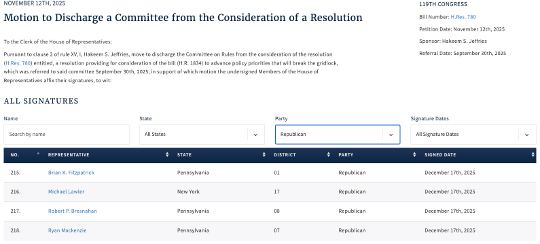
Allen Was Not One Of The Republican Signers On A Discharge Petition Led By House Minority Leader Hakeem Jeffries.
[Clerk of the U.S. House of Representatives, Discharge Petition No. 10, 11/12/25]
- House Minority Leader Jeffries’ Discharge Petition Sought To Extend ACA Premium Tax Credits For Three Years. According to Politico Pulse, "House Democrats could move as soon as tomorrow to force a vote on extending the expired Obamacare subsidies for three years, Meredith Lee Hill reports. This measure follows last month’s major setback for Speaker Mike Johnson, when four House Republicans broke from the party to support a discharge petition backed by Minority Leader Hakeem Jeffries to hold a vote." [Politico Pulse, 1/6/26]
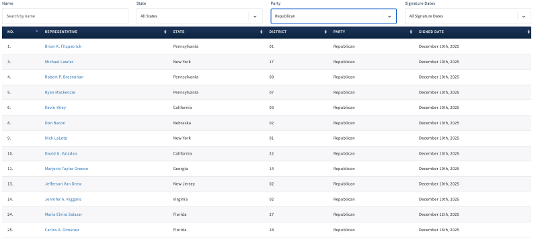
Allen Was Not One Of The Republican Signers On A Discharge Petition Led By Rep. Brian Fitzpatrick.
[Clerk of the U.S. House of Representatives, Discharge Petition No. 12, 12/10/25]
- December 2025: Fitzpatrick Filed A Discharge Petition Aimed At Extending ACA Premium Tax Credits For Two Years. According to a press release from Rep. Brian Fitzpatrick, "Today, Congressman Brian Fitzpatrick (PA-1) released the following statement after filing a discharge petition to bring his Bipartisan Health Insurance Affordability Act directly to the House floor for a vote, ensuring Congress takes action to prevent devastating health insurance premium increases when current protections expire at the end of the year: ‘Congress cannot sit idle while American families face a preventable crisis. Our job is to protect the people we serve, and that responsibility demands immediate action. […] Key Provisions of the Bipartisan Health Insurance Affordability Act The legislation advances five reforms designed to protect affordability, strengthen accountability, and ensure taxpayer value: Prevents premium spikes: Extends enhanced premium tax credits through 2027, to protect families from abrupt monthly cost increases. Restores Consumer Control: Stops unauthorized plan and subsidy changes by requiring consent and prompt notification before any modifications take effect. Shines Light on Middlemen: Ends hidden spread pricing, severs PBM profits from drug prices, and requires full rebate pass-through to ensure savings reach patients. Gives Families New Tools to Manage Costs: Expands access to Health Savings Accounts and simplifies premium payments to reduce disruptions in coverage. Smart Stewardship of Taxpayer Dollars: Modernizes eligibility and introduces a reasonable minimum contribution to protect long-term affordability and responsible stewardship of federal dollars." [Press Release – Rep. Brian Fitzpatrick, 12/10/25]
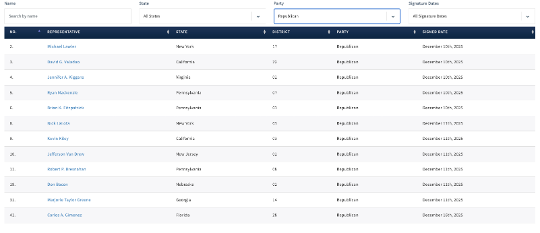
Allen Was Not One Of The Republican Signers On A Discharge Petition Led By Rep. Josh Gottheimer.
[Clerk of the U.S. House of Representatives, Discharge Petition No. 13, 12/10/25]
- December 2025: Gottheimer Filed A Discharge Petition Aimed At Extending ACA Premium Stax Credits For Two Years. According to a press release from Rep. Josh Gottheimer, "Today, December 11, 2025, U.S. Congressman Josh Gottheimer (NJ-5) released the following statement: ‘In less than three weeks, unless Congress acts now, Affordable Care Act tax credits will expire, and health insurance premiums will shoot up 175% — or $20,000 a year — for families in Jersey. This week, Congresswoman Jen Kiggans and I, with 36 of our Democratic and Republican colleagues, introduced new bipartisan legislation that includes a two-year extension of health insurance premium tax cuts for American families. It’s a commonsense proposal that will keep costs down and prevent families’ premiums from skyrocketing in January. But, the Speaker of the House is refusing to bring our legislation to the floor for a vote. So, our bipartisan group just launched a discharge petition to force an immediate vote in the House. We must get this done now. We must find common ground and lower health insurance premiums. Time is running out for families.’" [Press Release – Rep. Josh Gottheimer, 12/11/25]
¶ Allen voted for a bill that would weaken protections for people with pre-existing conditions and failed to address premium spikes
¶ December 2025: Allen Voted For The Lower Health Care Premiums For All Americans Act
2025: Allen Voted For The Lower Health Care Premiums For All Americans Act That Allowed The ACA Tax Credits To Expire. In December 2025, Allen voted for, according to Congressional Quarterly, “the bill that would expand the ability of small businesses to establish association health plans and bars states from preventing small businesses from obtaining stop-loss insurance for self-funded health insurance plans. It would codify and expand rules governing employer-funded health reimbursement arrangements and would allow employees in such arrangements to pay Affordable Care Act health insurance premiums through salary reductions. It would provide funding for ACA policy cost sharing reduction payments that reduce deductibles and copayments. It would prohibit plans from providing abortion-related care. It also would require pharmacy benefit managers to provide transparency regarding prescription drug costs and the drug rebates they receive.” The vote was on passage. The House passed the bill by a vote of 216 to 211. [House Vote 349, 12/17/25; Congressional Quarterly, 12/17/25; Congressional Actions, H.R. 6703]
¶ The Lower Health Care Premiums For All Americans Act Did Nothing To Address The Expiration Of ACA Enhanced Premium Tax Credits And Would Weaken Protections For People With Pre-Existing Conditions
The December 2025 Republican Health Care Bill Failed To Prevent Imminent Premium Spikes For More Than 20 Million People Who Relied On ACA Marketplace Plans. According to the Center on Budget and Policy Priorities, "The health bill House Republicans are preparing to bring to the floor this week not only fails to prevent imminent premium spikes for more than 20 million people in marketplace plans, but would raise costs even higher for many marketplace enrollees and weaken pre-existing condition protections for individuals and small businesses." [Center on Budget and Policy Priorities, 12/16/25]
- HEADLINE: "House Republicans Pass Health Care Plan Without Re-Upping Insurance Subsidies" [Politico, 12/17/25]
- HEADLINE: "House Passes GOP Health Bill Without Subsidies" [Axios, 12/17/25]
- HEADLINE: "House Passes GOP Health Care Bill Without Obamacare Subsidy Extension" [The Hill, 12/17/25]
- HEADLINE: "House Passes GOP Health Care Bill Without ACA Extension" [CBS News, 12/17/25]
The December 2025 Republican Health Care Bill Would Expand Association Health Plans, Which Would Result In Higher Underlying Premiums For Individuals And Small Businesses That Remained In ACA-Regulated Markets. According to the Center on Budget and Policy Priorities, "It would expand association health plans (AHPs), a type of health plan that trade associations, professional groups, and other organizations may offer their members, to cover self-employed individuals and small businesses as if they were large employers. By allowing more people to enroll in coverage not subject to ACA standards and consumer protections, this would segment insurance risk pools: individuals who are younger and healthier, or small businesses with younger or healthier employees, could get plans with lower premiums because they would be priced separately from ACA-compliant coverage and wouldn’t have to meet ACA standards such as having to cover a set of essential health benefits. As a result, individuals and small businesses remaining in ACA-regulated markets would see higher underlying premiums." [Center on Budget and Policy Priorities, 12/16/25]
The December 2025 Republican Health Care Bill Would Likely Lead To Higher Premiums For Older And Sicker Small Groups And Self-Employed People, Thereby Undermining Protections For People With Pre-Existing Conditions. According to the Center on Budget and Policy Priorities, "In addition, the bill would undermine protections for people with pre-existing conditions. While it would bar AHPs from rejecting individuals or charging them more based on certain health factors, it would give them greater ability to base a small group’s or self-employed person’s costs on their health risk compared to individual or small-group coverage. This would likely lead to higher premiums for older and sicker small groups and self-employed individuals, making such arrangements more attractive to healthier individuals and groups." [Center on Budget and Policy Priorities, 12/16/25]
¶ georgians faced dramatic premium increases as a result of the expiration of critical health care tax credits
HEADLINE: "Sticker Shock For Georgians As ACA Marketplace Enhanced Premium Tax Credits Set To Expire" [WABE, 12/10/25]
HEADLINE: "Over 200,000 Georgians Drop Health Coverage As ACA Premiums Skyrocket" [WRDW, 2/5/26]
2025: 1.5 Georgians Enrolled In ACA Marketplace Plans. According to the Kaiser Family Foundation, in 2025, 1,510,852 people in Georgia enrolled in an Affordable Care Act marketplace health insurance plan. [Kaiser Family Foundation, Viewed, 2/16/25]
¶ Allen’s Inaction Created A Dramatic “Subsidy Cliff”
The Expiration Of Enhanced ACA Premium Tax Credits Created A “Subsidy Cliff” Whereby If Households Earned Even $1 More Than A Specific Income Threshold They Could Lose All Eligibility For Assistance. According to CNBC, "For the first time in years, many Americans enrolled in a health insurance plan via the Affordable Care Act marketplace will need to keep a careful accounting of their annual income — or risk a hefty federal tax bill. Enhanced ACA subsidies lapsed at the end of 2025, leaving millions of households on the hook for higher insurance premiums. The lapse also reintroduced the so-called subsidy cliff, whereby households that earn even $1 more than a specific income threshold will lose all eligibility for subsidies, also known as premium tax credits. That income cutoff, which varies by family size, is $62,600 for a single person, $84,600 for a two-person household and $128,600 for a family of four in 2026, for example." [CNBC, 1/6/26]
- More Than Two Million Americans Had Incomes Near A “Subsidy Cliff.” According to CNBC, "More than 2 million people enrolled in an ACA marketplace plan have an income near the subsidy cliff. ACA enrollees also tend to have relatively volatile incomes, making it hard to predict their annual earnings, experts said." [CNBC, 1/6/26]
Households That Went Over The Income Limit Would Have To Pay Back Any Federal Assistance They Received For Premiums, Which Could Cost Thousands Of Dollars, When They Filed Their Taxes. According to CNBC, "Households over the limit would have to pay back any federal subsidies they received for premiums — potentially worth thousands of dollars — when they file taxes next year for 2026." [CNBC, 1/6/26]
Republicans’ Big Beautiful Bill Exacerbated The Problem By Stripping Away Guardrails Capping The Amount Of Excess Subsidies Households Are Required To Repay. According to CNBC, "The potential financial impact is exacerbated by a multitrillion-dollar legislative package known as the ‘big beautiful bill’ that Republicans passed over the summer, which stripped away guardrails capping the amount of excess subsidies households must repay, experts said." [CNBC, 1/6/26]
¶ 22 Million Americans Relied On ACA Premium Tax Credits To Afford Health Insurance
Approximately 22 Million Americans Relied On ACA Premium Tax Credits To Afford Health Insurance. According to CNBC, "About 22 million Americans received premium subsidies, also known as premium tax credits, in 2025. Households can opt to receive the tax credit in one of two ways: As a lump sum during tax season or as an advanced payment. Under the latter option, by far the most popular, the federal government issues the tax credit directly to a consumer’s insurer, which then lowers the consumer’s out-of-pocket premium. Consumers receive those advanced ACA subsidies based on an estimated annual income they provide when signing up for insurance. They must reconcile those subsidies during tax season and repay any excess tax credits to the IRS." [CNBC, 1/6/26]