¶ Overview
As the United States launched strikes on Iran, Flood supported the effort and said “the time to act is now.” As costs increased for Nebraskans, Flood claimed the war would be “well worth” the pain so many of his constituents faced.
Flood voted against multiple resolutions that would direct President Trump to remove troops from Iran, despite the high costs Nebraskans faced due to the war.
¶ Flood Repeatedly Defended Trump’s War With Iran
¶ Flood Supported The War With Iran And Claimed it would be “well worth” the pain
When Discussing High Costs Amid The United States’ War With Iran, Flood Said It Would Be “Well Worth A Lot Of The Pain That We've Had.” According to an interview with Rep. Mike Flood on “FLOOD: Well, simple. Iran can't have a nuclear weapon, a dirty bomb, access to it, enriched uranium. And this time it really has to happen. They have been delaying and hiding and just doing everything they can to maintain their grip on their terrorism regime. This needs to stop and it needs to stop once and for all. And I'm glad the president has drawn a bright line and said, listen, we have engaged because we want to make it safer for Americans, for our allies and for the world. Could have used more help along the way to get this done. But I think President Trump's going to drive a hard bargain and we have to get this stopped. And when we do, it will be well worth a lot of the pain that we've had. But let me tell you right now, it is tough at the pump. And I want to acknowledge that. I don't want to hide from it. It is it is painful for a lot of Americans. At the same time, we can't cut and run. We saw what a president what it looks like when the president did that in Afghanistan. That's not what we're doing here. We're going in a different direction.” [Live Now Fox, 5/31/26] (video) 00:08:15 -> 00:09:13
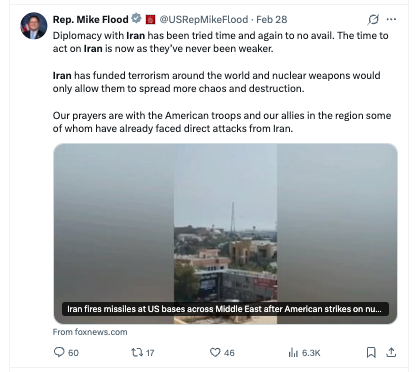
In Response To Trump’s Strikes On Iran, Flood Said “The Time To Act Is Now.” According to Rep. Mike Flood’s Twitter, “Diplomacy with Iran has been tried time and again to no avail. The time to act on Iran is now as they’ve never been weaker. Iran has funded terrorism around the world and nuclear weapons would only allow them to spread more chaos and destruction. Our prayers are with the American troops and our allies in the region some of whom have already faced direct attacks from Iran.”
[Twitter, @USRepMikeFlood, 2/28/26]
¶ Flood Repeatedly Voted Against Ending The United States’ Hostilities In Iran
¶ September 2026: Flood Voted Against Withdrawing US Troops From Iran
September 2026: Flood Voted Against Withdrawing US Troops From Iran. In September 2026, Flood voted against, according to Congressional Quarterly, “adoption of the concurrent resolution that would direct the president to remove U.S. armed forces from hostilities with Iran that Congress has not specifically authorized.” The vote was on adoption of the resolution. The House adopted the resolution by a vote of 220 to 204. [House Vote 307, 9/15/26; Congressional Quarterly, 9/15/26; Congressional Actions, H.Con.Res.93]
- The House Had Adopted Two Similar Non-Binding Resolutions Previously, With This Vote Coming Over 60 Days After President Trump Notified Congress That Hostilities Had Resumed In Iran. According to Congressional Quarterly, “The House has twice adopted similar resolutions, including one time when the Senate then approved the same resolution. But as a concurrent resolution, the measure Congress cleared did not have the weight of law to force President Donald Trump to withdraw troops from the war. The resolution the House is voting on this time is sponsored by Rep. Seth Moulton, D-Mass., and comes more than 60 days after the Trump administration notified Congress fighting in the war resumed, a timeline that some Republicans have given weight to.” [Congressional Quarterly, 9/15/26]
- The Congressional Budget Office (CBO) Reported That The Iran War Cost The Pentagon $38 Billion Through July And Would Cost An Additional Two To Three Billion Each Month It Goes On. According to Congressional Quarterly “The Iran war directly cost the Pentagon $38 billion through July and is likely to consume $2 billion to $3 billion more per month if recent hostilities in the region continue, the Congressional Budget Office reported Tuesday. The CBO report’s estimate of the war’s direct impact on the federal budget is made up mostly of the cost of replacing expended munitions, as well as the fiscal impact of equipment losses and expenses such as fuel and extra military pay.” [Congressional Quarterly, 9/16/26]
- The Estimated Cost Did Not Include Repairs To Hundreds Of Damaged US Buildings In The Middle East. According to Congressional Quarterly, “The IG estimate, like CBO’s, does not include the price of potential repairs to what the IG said are ‘hundreds’ of U.S. military buildings and structures damaged or destroyed during the war in Kuwait, Bahrain, Qatar, UAE, Saudi Arabia, Iraq, Oman and Jordan.” [Congressional Quarterly, 9/16/26]
- The CBO Found That 40 Percent Of Inflation In “Personal Consumption Expenditures” In The Second Quarter Of 2026 Resulted From Higher Energy Costs Related To The War. According to Congressional Quarterly, “Besides the direct costs to the government and the opportunity cost of diminished munitions stocks, CBO’s analysts said more than 40 percent of inflation in ‘personal consumption expenditures’ in the second quarter of 2026 was due to higher energy costs. Those costs rose due to supply disruptions in the Strait of Hormuz and the Red Sea, the report said. In the first quarter of 2027, CBO projected that the war will add roughly 0.5 percentage points to personal consumption inflation, compared to CBO’s estimate before the war. This higher inflation, in turn, will raise interest rates on Treasury securities, the analysts said.” [Congressional Quarterly, 9/16/26]
¶ July 2026: Flood Voted Against Removing U.S. Armed Forces From Hostilities Against Iran Unless Explicitly Authorized By A Declaration Of War
2026: Flood Voted Against Terminating Hostilities Against Iran Without A Declaration Of War. In May 2026, Flood voted against, according to Congressional Quarterly, “adoption of a resolution that would direct the president to remove U.S. Armed Forces from hostilities with Iran.” The vote was on passage. The House adopted the resolution by a vote of 215 to 208. [House Vote 199, 6/3/26; Congressional Quarterly, 6/3/26; Congressional Actions, H.Con.Res. 86]
- The Vote Occurred As The War Entered Its Fourth Month, And Was The House’s Fourth Vote On The War As Gas And Food Prices Continued To Rise. According to Congressional Quarterly, “Either way, supporters say the House adopting the resolution sends an important message to Trump that Congress is fed up with the war as it lumbers into its fourth month. ‘We're now past 90 days, there seems to be no end to this war, and folks want some accountability, Democrats and Republicans,’ New York Rep. Gregory W. Meeks, the ranking member of the House Foreign Affairs Committee and the sponsor of Wednesday’s resolution, said ahead of the vote. ‘The American people are suffering. The cost of gas continues to go up, the cost of food and inflation keeps going up.’ ‘So it's been building and building,’ Meeks added. Wednesday’s vote was the House’s fourth on an Iran war powers resolution since the war started at the end of February, with each vote getting tighter than before. In the third vote last month, the measure was rejected 212-212.” [Congressional Quarterly, 6/3/26]
- GOP Leadership Delayed The Vote Through A Week-Long Recess When It Became Clear It Would Pass. According to Congressional Quarterly, “The House had originally been slated to vote on Meeks’ resolution before the Memorial Day recess. But when it became apparent the resolution was likely to be approved, particularly with a handful of Republican absences, GOP leadership yanked the vote from the schedule. Republicans could not delay the vote beyond Wednesday since the 1973 War Powers Resolution (PL 93-148) requires the House to vote within three legislative days of a measure being called up on the floor.” [Congressional Quarterly, 6/3/26]
- The Vote Came Amidst Ongoing Strikes Despite A Proclaimed Ceasefire With Iran Claiming It Was Suspending Talks Following An Israeli Incursion Of Lebanon. According to Congressional Quarterly, “The growing congressional angst over the war comes as an already fragile ceasefire appears increasingly tenuous and the Trump administration’s negotiations with Iran stumble. Early Wednesday morning, Iran launched a missile and drone attack at an airport in Kuwait, killing an Indian national and injuring dozens of other people, in what Tehran described as a response to U.S. strikes on Iran the night before. U.S. Central Command said Iran also targeted U.S. forces in Kuwait but that air defenses shot down the drones and ‘ensured no American personnel or assets were harmed.’ On Tuesday evening, Central Command said it conducted ‘self-defense strike’ on Iran’s Qeshm Island in response to Iran firing missiles and drones toward Kuwait and Bahrain. Hours earlier, Central Command also said U.S. forces fired a Hellfire missile into the engine room of a Botswana-flagged oil tanker that it alleged was trying to evade the U.S. blockade against Iranian ports. The exchange of fire comes amid on-again-off-again talks to end the war. On Monday, Iran said it was suspending talks with the United States in response to Israel’s incursion into Lebanon. But Trump maintained that talks are continuing despite Iran’s statement, posting on Truth Social on Tuesday that ‘the conversations between us have been going on continuously.’” [Congressional Quarterly, 6/3/26]
¶ June 2026: Flood Voted Against Removing U.S. Armed Forces From Hostilities Against Iran Unless Explicitly Authorized By A Declaration Of War
2026: Flood Effectively Voted Against Withdrawing US Troops From Iran. In July 2026 Flood voted against, according to Congressional Quarterly, “motion to discharge the Foreign Relations Committee from further consideration of the joint resolution that would direct the president to withdraw U.S. armed forces hostilities against Iran not authorized by a declaration of war or specific authorization for military force.” The vote was on adoption of the resolution. The House adopted the resolution by a vote of 214 to 208. [House Vote 282, 7/23/26; Congressional Quarterly, 7/23/26; Congressional Actions, H.Con.Res.89]
- The Senate Voted Against Ending The War In Iran On The Same Day. According to Congressional Quarterly, “The House and Senate, in votes Thursday on ending the Iran war, came to different conclusions, but the majority of voting members of Congress said it is time to bring U.S. troops home. The House, for the second time, formally called on President Donald Trump to end the war, approving 214-208 a nonbinding concurrent resolution (H Con Res 89) by Rep. Pramila Jayapal, D-Wash.” [Congressional Quarterly, 7/23/26]
- The Vote Came After The Trump Administration Declared A Memorandum Of Understanding From The Previous Month “Over”, With Three US Troops Killed The Weekend Before And Houthi Strikes Against Two Saudi Tankers The Day Before. According to Congressional Quarterly, “Last month, the Trump administration announced it had reached a memorandum of understanding with Iran. But less than a month later, Trump declared the MOU ‘over.’ On July 10, he formally notified Congress fighting in the war had resumed. Over the weekend, three U.S. troops were killed in an Iranian attack on a base in Jordan, while a fourth U.S. service member in Iraq died during what was supposed to be a controlled detonation of an unexploded Iranian drone. Iran’s proxy group in Yemen, the Houthis, struck two Saudi tankers in the Red Sea on Wednesday. Such attacks could choke off another bottleneck in the global economy in addition to the ongoing throttling of trade in the Strait of Hormuz as a result of the war.” [Congressional Quarterly, 7/23/26]
- As Hostilities Resumed, The Price Of Crude Oil Exceeded $100 Per Barrel For The First Time Since May With The Average Cost Per Gallon Of Gas Exceeding $4. According to Congressional Quarterly, “Apparently in response, the price of a barrel of Brent crude oil exceeded $100 on Thursday for the first time since May. The national average price of a gallon of gas in the United States averaged just over $4 on Thursday, per AAA. And polls show the war is unpopular among Americans.” [Congressional Quarterly, 7/23/26]
¶ May 2026: Flood Voted Against Terminating Hostilities Against Iran Without A Declaration Of War
5/14/26: Flood Voted Against Terminating Hostilities Against Iran Without A Declaration Of War. In May 2026, Rep. Mike Flood voted against, according to Congressional Quarterly, “the concurrent resolution that would direct the president to terminate the use of U.S. armed forces from hostilities against Iran unless explicitly authorized by a declaration of war or a specific authorization for use of military force against Iran. It would clarify that nothing in the measure could be construed to disrupt intelligence, counterintelligence or investigative activities.” The vote was on passage. The House rejected the resolution by a vote of 212 to 212. [House Vote 170, 5/14/26; Congressional Quarterly, 5/14/26; Congressional Actions, H.Con.Res. 75]
¶ April 2026: Flood Voted Against Directing The President To Withdraw Troops From Iran Unless Authorized By Congress
4/16/26: Flood Voted Against Directing The President To Withdraw Troops From Iran Unless Authorized By Congress. In April 2026, Rep. Mike Flood voted against, according to Congressional Quarterly, “the concurrent resolution that would direct the president to terminate the use of U.S. armed forces from hostilities against Iran unless explicitly authorized by a declaration of war or specific authorization for use of military force against Iran. The measure would exempt the use of U.S. armed forces that may be necessary to defend the U.S. or a U.S. ally or partner from imminent attack.” The vote was on passage. The House rejected the resolution by a vote of 213 to 214. [House Vote 114, 4/16/26; Congressional Quarterly, 4/16/26; Congressional Actions, H.Con.Res.40]
¶ March 2026: Flood Voted Against Directing President Trump To Withdraw Troops From Iran
3/5/26: Flood Voted Against Directing President Trump To Withdraw Troops From Iran. In March 2026, Flood voted against, according to Congressional Quarterly, “the concurrent resolution that would direct the president to terminate the use of U.S. armed forces from hostilities against Iran or any part of its military, unless explicitly authorized by a declaration of war or specific authorization for use of military force against Iran.” The vote was on passage. The House rejected the concurrent resolution by a vote of 212 to 219. [House Vote 85, 3/5/26; Congressional Quarterly, 3/5/26; Congressional Actions, H.Con.Res.38]
¶ Trump’s War with Iran Raised Prices On Nebraskans
¶ Gas Prices In Nebraska Surged Amid The United States’ War With Iran
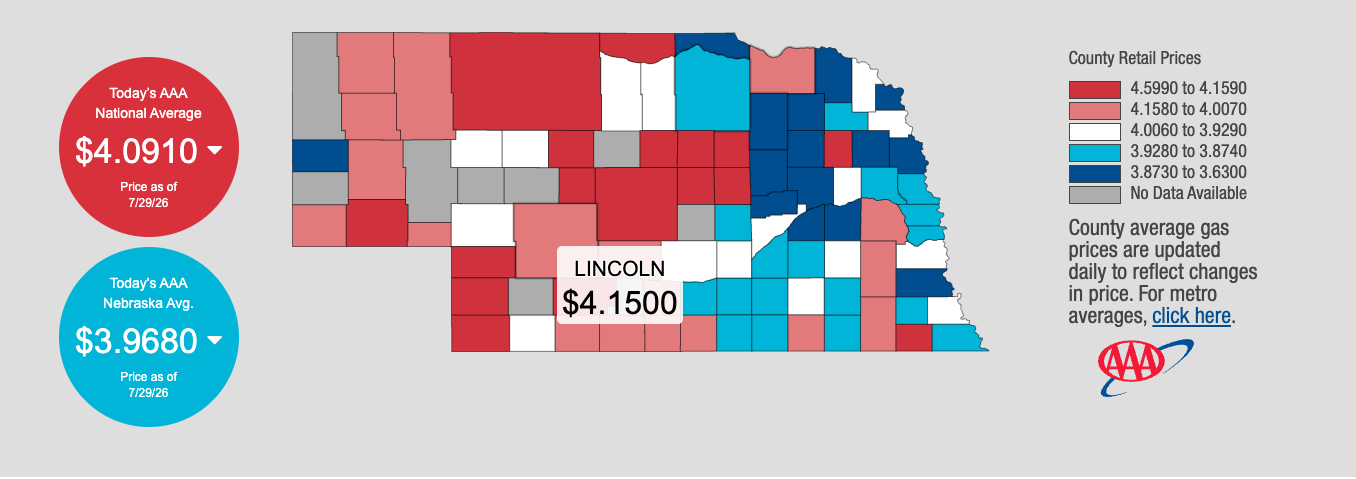
7/29/26: Gas Prices In Lincoln County Averaged $4.15 Per Gallon And Across The State Of Nebraska Gas Prices Averaged $3.96 Per Gallon. According to AAA, as of July 28, 2026, gas prices in Lincoln County averaged $4.15 per gallon and prices averaged $3.96 per gallon across the state of Nebraska.
[AAA Fuel Prices – Nebraska, Viewed 7/29/26]
HEADLINE: "Gas Prices Rise More Than 15 Cents In Nebraska" [Beatrice Daily Sun, 7/29/26]
July 2026: The National Average Price For A Gallon Of Gas Was Reapproaching $4 After Trump Declared A Ceasefire Was Over. According to Arizona’s Family, "Gas prices continue to inch up after President Donald Trump declared the ceasefire agreement with Iran was ‘over.’ AAA reported the average price for a gallon of regular gasoline was just shy of $4, at $3.98 a gallon. On Thursday, the average price of diesel was back up to about $5 a gallon. Oil and gas prices had been declining after the U.S. and Iran signed a peace plan to end the war in June." [Arizona’s Family, 7/17/26]
- The War In Iran Caused Fuel Inventories To Plunge To Historic Lows, Leading To A Major Surge In Gas Prices. According to the Washington Post, "Americans face a new round of punishing price increases for fuel and other products as oil and gas inventories plunge to historic lows around the world because of the war in Iran, energy executives and analysts warn. Fuel stocks are so low, experts said, that even an abrupt agreement between the United States and Iran and an immediate reopening of the Strait of Hormuz — through which one-fifth of the world’s oil and natural gas supplies passed before the war — may not stop fuel prices from soaring anew by the July Fourth holiday." [Washington Post, 6/3/26]
¶ Nebraska Farmers Faced High Costs Due To The War With Iran
Doug Bartek, The Chair Of The Nebraska Soybean Association, Said The High Cost Of Fuel, Equipment, And Fertilizer Compounded By The Iran War Made Farmers Feel “Painted In The Corner.” According to PBS, "Strong winds whipped around Doug Bartek, a fifth-generation farmer, as he headed into a grain bin to shovel soybeans onto a conveyor chute. The 60-year-old was anxious at the onset of the spring planting season, rattling off the long list of issues affecting his family's livelihood at their 2,000-acre farm near Wahoo, Nebraska. The high cost of fuel, equipment, and fertilizer — compounded by the Iran war — and also tariffs, perceived ‘price gouging’ by suppliers, and low soybean prices driven by a global supply glut. All of it weighs on Bartek, who is chairman of the Nebraska Soybean Association. ‘Our biggest struggles are our inputs, be it fertilizer, seed, chemical, parts,’ Bartek said. ‘There has been so much drastic markup in all of these. And I just kind of feel like the farmer's kind of painted in the corner.’" [PBS, 4/13/26]
April 2026: Rural Mainstreet Index Said High Prices From The Iran Conflict Contributed To A Dire Situation For Rural Economies That Were Being Sent Into Recessions. According to Nebraska Public Media, "More than half of rural bank CEOs across a 10-state region say their local economies are in a recession, according to the April Rural Mainstreet Index. The index measures economic conditions in rural communities dependent on agriculture and energy. The index was created by Ernie Goss, an economist and professor at Creighton University, and Bill McQuillan, former chairman of the Independent Community Banks of America. […] ‘Weakness in farm commodity prices and elevated agriculture input costs are spilling over into the rural business community,’ Goss said. The ongoing war in Iran is adding to an already difficult situation by driving up diesel fuel and fertilizer costs, two of farming's most necessary expenses." [Nebraska Public Media, 4/29/26]
HEADLINE: "The Iran War Creates ‘The Worst-Case Scenario’ For Nebraska Farmers" [Nebraska News Service, 4/25/26]
HEADLINE: "Farmers Were Already Hurting. The Iran War Made It Worse" [NOTUS, 6/11/26]
¶ The Iran War Increased The Cost Of Fresh Food And Everyday Goods
July 2026: Prices For Fresh Food, School Supplies, And Any Goods That Required Shipment Were Expected To Increase Amid Energy Price Increases Due To The United States’ War With Iran. According to PBS, “Already feeling pinched since the start of the Iran war, consumers are likely to feel more pain ahead as oil prices pushed past $100 a barrel Thursday amid renewed fighting and military strikes that have left global oil supplies stranded in the Middle East. The elevated price marked a turn from lower oil prices enjoyed briefly when hostilities between the U.S. and Iran waned in June. Brent crude, the international standard, last reached $100 a barrel in May. Companies that produce and sell fresh food, school supplies and anything that gets shipped using fuel reported cost impacts from an earlier spike in energy prices after the U.S. and Israel attacked Iran. They're likely to continue passing some of their increased expenses to consumers.” [PBS News, 7/24/26]
HEADLINE: "Higher Prices For Gas, Groceries And Flights Will Likely Outlast The Iran War" [AP News, 6/16/26]
Tomatoes, Bananas, And Onions Experienced Major Price Hikes Since The Beginning Of The War. According to Fortune, "The U.S., Israel, and Iran agreed to a two-week ceasefire on Tuesday, but the sticker shock you’ve been feeling every time you go to the grocery store will get worse if the war continues. One of the first places you’ll feel it will be the produce aisle, experts say. A Fortune analysis of produce wholesale prices from USDA data found grocery-cart staples such as tomatoes, bananas, and yellow onions have experienced significant price spikes since the war began. The United Nations reported its global food price index rose by 2.4% in March, the second consecutive month of rising prices." [Fortune, 4/8/26]