¶ Overview
- Bouchard claimed Trump was “putting the right laws in place” to help small businesses thrive, and Trump’s tariffs were creating a “level playing field” for Americans. He said he wanted to “continue” the economy Trump created and claimed Trump’s economic agenda was benefitting MI-10 residents.
- Trump’s tariffs and economic agenda caused operational costs to rise for Michigan businesses and was particularly hurtful to the automotive industry, which relied on imported parts. After the tariffs were first enacted, Jeep’s parent company temporarily laid off 900 workers at plants across Michigan and Indiana.
- Bouchard said he believed in Trump’s “peace through strength” approach to foreign policy and would continue fighting for that approach if elected to Congress. He was equally supportive of Trump’s war in Iran, claiming the war was evidence of Trump “putting our country first.”
- As a result of the war in Iran, the Michigan Farm Bureau warned farmers to expect rising costs through 2027. Fertilizer costs had risen sharply as a result of the war. Gas prices in the Detroit metro area averaged $3.93 per gallon and diesel averaged $4.93 per gallon. Bouchard supported the war despite opposition from Macomb County residents.
- Trump’s war in Iran was projected to cost Americans an extra estimated $235 to fill up their car with gas, and rising fuel costs resulted in corporations beginning to pass fuel surcharges onto American consumers. Americans were also primarily concerned with how the war would impact their wallet, with a Ipsos poll finding that 56 percent of Americas expected Trump’s war in Iran to have a “mostly negative impact” on their personal financial situation.
¶ Bouchard Supported Trump’s Tariffs And Said He Wanted To “Continue” The Economy Trump Created
¶ Bouchard Claimed Trump Was “Putting The Right Laws in Place” To Help Small Businesses
November 2025: Bouchard Claimed Trump Was “Putting The Right Laws In Place” To Help Small Businesses Thrive. According to The Detroit News, “On the economy, he said that he's a strong proponent of deregulation and creating conditions for small businesses to thrive. ‘I think as a federal government, the Biden administration failed to do that, and President Trump is putting the right laws in place to enable them. I want to help him do that.’” [Detroit News, 11/6/25]
Bouchard Said Trump’s Tariffs Were About Creating A “Level Playing Field” For The U.S. To Compete On With Other Nations. According to The Detroit News, “Bouchard, asked about Trump's tariffs, said he believes in a ‘free market’ but ‘we need to have a level playing field. Because when we do, America will dominate every industry.’ Tariffs could have a significant impact on the 10th District's manufacturing and automotive-heavy economy, which relies strongly on international trade. Trump has said his steep import tax levies would stop other countries from taking advantage of U.S. businesses and result in long-term gains to the country's industrial base, though some economists have been skeptical of that notion.” [Detroit News, 11/6/25]
- Bouchard Claimed The Tariffs Were “Temporary” And The U.S. Was Being “Taken Advantage Of” Under The Current International Trade Structure. According to The Detroit News, “Bouchard said he thinks the tariffs are ‘temporary’ and agreed with Trump's logic. ‘I'm against our country being taken advantage of ...’” [Detroit News, 11/6/25]
¶ Bouchard Said He Wanted To “Continue” THe Economy Created BY Trump
Bouchard: “I Want To Continue This Economy.” According to an interview Michael Bouchard gave on Fox News Digital, “BOUCHARD: I want to continue this economy. I want to rebuild this economy, to not just win the future wars, but to prevent them. I think if we truly stand up this economy to what it can be, we won't have the future war that everyone keeps talking about because we have built the best equipment in this district. So the people here are the salt of the earth. They want to work hard, they want to raise a family and they want to send them to school in an environment they know that… that child's going to be taken care of. They don't want politics to come into play. They just want to have a good life. And I want to give them that. I want to have, I want them to have that ability.” [Fox News Digital, 11/11/25] (video)
Bouchard Praised Trump’s Economic Agenda For Putting “American Workers First” And Said Michiganders Could “Feel The Difference.” According to an opinion by Michael Bouchard published in The Detroit News, “In his first year back in office, Trump did exactly what he said he would do: he put American workers first, stood up to bad trade deals and made it clear that the auto industry would not be sacrificed on the altar of globalism or bureaucratic fantasy. You can feel the difference here at home.” [Michael Bouchard Opinion – Detroit News, 1/14/26]
- Bouchard Claimed That Thanks To Trump, Michigan Auto Production Was “Stabilizing” And Investment Was Returning To The State. According to an opinion by Michael Bouchard published in The Detroit News, “Auto sales are up. Production is stabilizing. Investment is coming back to places that were written off by coastal elites years ago. That doesn’t happen by accident; it happens when a president understands that the strength of this country starts on factory floors, not in think tanks.” [Michael Bouchard Opinion – Detroit News, 1/14/26]
Bouchard Claimed Trump’s Economic Approach Was “Paying Off” And Families In MI-10 Had A “Brighter Future” Thanks To Trump. According to an opinion by Michael Bouchard published in The Detroit News, “When politicians talk casually about ‘transitioning away’ from the auto industry, they’re talking about real people. Trump understood that from day one. Instead of outsourcing our future, he fought to bring manufacturing back to America. Instead of lecturing workers about climate mandates written by bureaucrats who have never held a wrench, he focused on affordability, energy independence and keeping jobs here, where they belong. And in Michigan’s 10th District, that approach is paying off. Suppliers are busier, skilled trades are in demand and families have a brighter future than they did just a few years ago.” [Michael Bouchard Opinion – Detroit News, 1/14/26]
Bouchard Claimed Trump Was Fighting For MI-10 Residents And Said He Would Fight To “Make Sure This Comeback Continues.” According to an opinion by Michael Bouchard published in The Detroit News, “He didn’t forget Detroit once the election was over and he didn’t sell out Michigan to please foreign competitors or activist donors. He showed up with actions, not just words. As someone running to represent Michigan’s 10th District in Congress, I personally know what’s at stake. Our communities don’t need more politicians who talk down to them; they need leaders who fight for them. The president has done that. Now, it’s on the rest of us to make sure this comeback continues, for our workers, families and the next generation that deserves the same opportunities my grandfather had.” [Michael Bouchard Opinion – Detroit News, 1/14/26]
¶ Trump’s Tariffs raised costs on michiganders and hindered its automotive industry
HEADLINE: "Tariffs Hit Small Michigan Retailers Hard, Prompting Panic Buying, Cost Cutting" [Detroit Free Press, 5/23/25]
HEADLINE: "Michigan Braces For Fallout As Trump Tariffs Target State’s Top 3 Trading Partners" [Michigan Advance, 2/3/25]
OPINION: “Not Your Grandfather’s Factory: Why Tariffs Won’t Help Midwest Manufacturing” [John Austin Opinion – Brookings Institution, 1/22/26]
HEADLINE: "The First Victim Of Trump’s Trade War: Michigan’s Economy" [Wall Street Journal, 4/6/25]
- Nearly 20 Percent Of Michigan’s Economy Was Tied To The Auto Industry, Which Was Increasingly Dependent On Parts And Vehicles From Tariffed Nations. According to The Wall Street Journal, “If President Trump’s trade war has a physical battleground, it is Michigan, where companies and workers are already feeling the beginning of an onslaught that could blow a hole in the state’s economy. Nearly 20% of the economy is tied to the auto industry, which has become increasingly dependent on parts and vehicles from Canada, Mexico and China—imports Trump hit with steep tariffs in recent weeks. This trade has grown so large that Michigan ranks fifth in the nation by the size of its imports and exports, even though its total economy ranks 14th. Detroit’s automotive executives have shifted into battle mode. They are stockpiling imported components, wrestling with suppliers over price increases and setting up war rooms to figure out how to cut costs.” [Wall Street Journal, 4/6/25]
- Automotive Companies In Michigan Began Stockpiling Imported Components, Predicting “Chernobyl” If Tariffs Were Broadly Applied To Imported Parts. According to the Wall Street Journal, “Detroit’s automotive executives have shifted into battle mode. They are stockpiling imported components, wrestling with suppliers over price increases and setting up war rooms to figure out how to cut costs. […] One auto executive early last week darkly predicted ‘Chernobyl’ if tariffs broadly hit imported parts, which they’re scheduled to do next month. Industry executives and analysts later said what the administration outlined Wednesday was worse than they expected.” [Wall Street Journal, 4/6/25]
- April 2025: After Tariffs Took Effect, Stellantis, Jeep’s Parent Company Temporarily Laid Off 900 Workers In Michigan And Indiana. According to The Wall Street Journal, “Workers at the state’s biggest auto factories are tightening their belts, too, in case tariffs spark layoffs by causing a spike in vehicle prices and a drop in demand. Some early moves have added to their jitters. Hours after the latest tariffs took effect last week, Jeep parent Stellantis temporarily laid off about 900 workers in Michigan and Indiana who supply parts to factories in Canada and Mexico that the company idled at the same time. One auto executive early last week darkly predicted ‘Chernobyl’ if tariffs broadly hit imported parts, which they’re scheduled to do next month. Industry executives and analysts later said what the administration outlined Wednesday was worse than they expected.” [Wall Street Journal, 4/6/25]
According to Michigan-Based Consulting Firm Anderson Economic Group, Trump’s Tariffs Were Expected To Add Up To $12,000 To The Price Of Many New Cars. According to The Wall Street Journal, “Some forecasts for the industry are dire. Anderson Economic Group, a Michigan consulting firm, estimates the tariffs will add $2,500 to $12,000 to the price of many new cars, and up to $20,000 for luxury imports. That will push new vehicles further beyond the reach of consumers already struggling with average prices of roughly $48,000. ‘This is going to have a dramatic negative effect on car sales in the United States…and there will be production shutdowns,’ said Patrick Anderson, the firm’s CEO. ‘The epicenter for job losses due to these tariffs is somewhere between Detroit, Michigan, and Windsor, Canada.’” [Wall Street Journal, 4/6/25]
The Executive Director Of MichAuto, The Automotive Arm Of The Detroit Regional Chamber, Stressed That Trump’s Tariffs “Disproportionately Negatively Impacted” Michigan Businesses. According to The Detroit News, “The Supreme Court's decision to strike down a pillar of President Donald Trump's sweeping tariff policies could have broad impacts on Michigan's trade-reliant economy, though little will change for the state's signature auto industry. ‘The decision released this morning from the Supreme Court, striking down the use of the International Emergency Economic Powers Act, correctly recognizes that the law was misapplied when targeting our friendly trading partners in North America and elsewhere,’ said Glenn Stevens, executive director of MichAuto, the automotive arm of the Detroit Regional Chamber. ‘While we recognize that other avenues exist for the Administration to again impose these tariffs, we continue to stress that Michigan's businesses are disproportionately negatively impacted by tariffs, especially in our automotive, manufacturing, and agriculture sectors,’ he added in a statement.” [Detroit News, 2/20/26]
- A Detroit-Based Law Firm Advised Automakers To Pursue Litigation Against The Trump Administration In An Attempt To Get Tariff Refunds. According to The Detroit News, “Jennifer Smith-Veluz, a Washington, D.C., international trade law attorney for the Detroit-based firm Butzel Long, which specializes in representing auto suppliers, said she’s telling clients that they will need to file a lawsuit with the U.S. Court of International Trade if they want to get a tariff refund. ‘Refunds are not going to be forthcoming form this administration, because they’re sore about the decision,’ she said. ‘It’s going to have to be litigated, and the president indicated as such.’ But even for many auto suppliers, it will likely make sense to try to get that money back, even if they have to go to court, Smith-Veluz said. While the Section 232 tariffs on autos and auto parts weren’t impacted by Friday’s Supreme Court decision, suppliers were often still on the hook to pay tariffs on other goods that did fall under the court’s decision — like on raw materials they need to make the car parts, or certain parts that didn’t fall under the 232 requirements.” [Detroit News, 2/20/26]
More Than 60 Percent Of Michigan Businesses Imported Goods From Other Countries. According to Detroit Free Press, “The majority of Michigan businesses are navigating tariffs on imports from several countries and are making decisions on whether to stockpile, change suppliers and raise prices for customers. More than 60% of Michigan businesses import goods from other countries, according to a recent survey by the Michigan Retailers Association, which represents about 5,000 members and 15,000 stores and websites across the state. China, Canada and Mexico were listed as the top countries from which retailers import goods, the MRA said, followed by Vietnam, India, Italy, Spain, France and others.” [Detroit Free Press, 5/23/25]
A Michigan Department Of Agriculture And Rural Development Report Found That Trump’s Tariffs “Increased Food Prices, Reduced Agriculture Exports And Generated Uncertainty Throughout Michigan’s Food And Agriculture Industry.” According to a press release from Gov. Gretchen Whitmer, “Today, ahead of a speech from Governor Whitmer on tariffs and the state budget, the Michigan Department of Agriculture and Rural Development (MDARD) released a new report indicating that surging federal tariffs have increased food prices, reduced agriculture exports and generated uncertainty throughout Michigan’s food and agriculture industry. This report comes as a response to Governor Whitmer’s executive directive asking various state offices to investigate, calculate, and report the latest impact of tariffs on Michigan’s economy.” [Press Release – Gov. Gretchen Whitmer, 9/15/25]
¶ Bouchard Endorsed Trump’s “Peace Through Strength” Approach To Foreign Policy That Made Life More Unaffordable For Michiganders
¶ Bouchard Said He Believed In “Peace Through Strength” And Praised Trump For Backing American Troops
Bouchard Said He Believed In “Peace Through Strength” And Claimed U.S. Adversaries Were “Too Scared To Attack” American Troops Abroad Thanks To Trump. According to The Detroit News, “‘I am pro-immigration. I want easy legal immigration, but I want lawful immigration. I want to enforce our laws,’ Bouchard said. He said prosecutors in the United States are not enforcing laws, and that he believes in ‘peace through strength’ on the international stage. ‘That's not just a slogan to me. I've seen it. I've lived it firsthand,’ he said, describing the so-called Twelve Day War between Israel and Iran earlier this year. ‘I was in Iraq, and we thought that a lot of Iranian-aligned proxies were going to attack us. They didn't. And when we asked why at the end and did a debrief, it was because of President (Donald) Trump's strong leadership. They were too scared to attack us.’” [Detroit News, 11/6/25]
February 2026: Bouchard Vowed To “Continue Fighting For Peace Through Strength Policies” If Elected To Congress. Michael Bouchard tweeted, “Yesterday, at the Air Force Association Business Breakfast, We got a behind the scenes look at how the 2026 Selfridge Air Show is coming together. It’s going to be great! Thank you to the Michigan Air Force Association and Brig Gen(Ret.) Doug Slocum for having me. In Congress, I will continue fighting for peace through strength policies and always support our military. 🇺🇸 #selfridgeairshow” [Twitter, @BouchardforMI, 2/14/26]
Bouchard: “Peace Through Strength Works.” Michael Bouchard tweeted, “When our enemies believe the response will be overwhelming, they back down. That’s not luck, that’s leadership. Peace through Strength works, I’ve seen it first hand” [Twitter, @BouchardforMI, 1/13/26] (video)
¶ Bouchard Supported Trump’s War In Iran
Bouchard Claimed He Opposed Endless Wars But Endorsed Trump’s Military Action In Iran And Claimed By Starting A War In Iran, Trump Was “Putting Our Country First.” Michael Bouchard tweeted, “When your favorite chant is ‘death to America’, we will take you at your word and respond accordingly. Read my full statement on Operation Epic Fury below ⬇️”
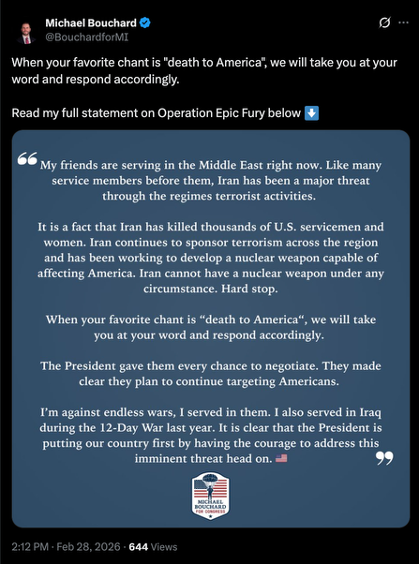
[Twitter, @BouchardforMI, 2/28/26]
3/30/26: Bouchard Criticized Democratic Michigan Senate Candidate Abdul El-Sayed For Refusing To Comment On The Death Of Iran Supreme Leader Khamenei And Called Iran “Our Enemy.” Michael Bouchard tweeted, “As a veteran who just got back from Iraq, l saw the forces Khamenei was using to target Americans everyday. This is the kind of left wing craziness we need to standup to and stop in its tracks. Abdul El-Sayed is a leading candidate for the United States Senate... he is openly saying he and his supporters are sad a mass terrorist is no longer able to hurt more people. No equivocation, no defending terrorists, no supporting our enemies. 🇺🇸” [Twitter, @BouchardforMI, 3/30/26]
Bouchard Reposted A Message From Rep. Pat Harrigan Where Harrigan Said He Liked Trump’s Military Action In Iran And Claimed Such Action “Prevents Long Wars And Protects American Lives.” According to a post on Michael Bouchard’s twitter, Bouchard retweeted a Rep. Pat Harrigan tweet, “The world is a dangerous place. When nations threaten the United States of America or its close allies, President Trump is very clear: we will seek terms of peace. But if peace is unobtainable, we are going straight for the jugular, because we are done getting nothing done. Because the world deserves peace, and to be free of leaders who oppress and oppose peace. And simply, more than anyone else in the world by a factor of ten, because we can. This ain’t your father’s regime change. It’s not the Global War on Terror. It’s not even war. It’s avoiding war through the limited, extremely violent and decisive use of force that achieves decisive overmatch and ends the ability for conflict altogether. It is reshaping the globe and the balance of power in favor of the United States of America again. We are rolling the tables. Anyone who has been to war, hates war. But I like what we’re doing, and why. Because decisive strength is what prevents long wars and protects American lives.” [Twitter, @RepPatHarrigan, 2/28/26]
¶ Trump’s War In Iran and “Peace Through Strength” Approach To Foreign Policy Made Life Less Affordable For MICHIGANDERS
¶ The U.S.-Iran War Disrupted Shipments Through The Strait Of Hormuz, Causing Fertilizer Costs To Rise For Michigan Farmers
In January 2026, The Michigan Farm Bureau Said Michigan Farmers Should Expect Rising Costs For 2026-2027. According to Detroit Free Press, “Fertilizer costs are rising as the U.S.-Iran war disrupts shipments through the Strait of Hormuz, and Michigan farmers are feeling the impact. Iran has blocked maritime traffic through the Strait of Hormuz, attacking ships in the area, USA TODAY reported. The blockage of a critical transportation corridor for fertilizer, oil and other commodities headed to the United States represents a significant issue for American farmers, including in Michigan. Large volumes of fertilizer inputs, including urea, ammonia, phosphates and sulfur, move through the Strait of Hormuz each year, creating a major choke point for agricultural supply chains, the Farm Journal reported. […] The Michigan Farm Bureau in January said farmers should expect rising costs for 2026-27. The farm group said fertilizer costs already had risen by 37% since 2020.” [Detroit Free Press, 3/12/26]
- Progressive Farmer Reported Urea Fertilizers Were Up 5 Percent From January To February. According to Detroit Free Press, “Progressive Farmer reported on March 4 that anhydrous ammonia costs already were up 15% from a year ago. In addition, urea fertilizers were up 5% from January to February. ” [Detroit Free Press, 3/12/26]
The American Farm Bureau Federation Said The Price Of Fertilizer Had Risen Sharply Due To Disruptions To The Strait Of Hormuz Amid The U.S. War With Iran. According to Detroit Free Press, “Yes, the price of fertilizer has risen sharply due to disruptions to the Strait of Hormuz amid the U.S. war with Iran, the American Farm Bureau Federation said. ‘Nitrogen fertilizer supply chains are closely tied to the region, which accounts for nearly 49% of global urea exports and about 30% of global ammonia exports. Major exporters include Iran, Qatar, Saudi Arabia and Egypt,’ the Farm Journal reported. Fertilizer is typically one of the larger expenses involved in agricultural production, according to the USDA. Fertilizer costs account for 21% of total corn production costs.” [Detroit Free Press, 3/12/26]
- Fertilizer Was Typically One Of The Most Significant Costs Involved In Agricultural Production. According to Detroit Free Press, “Yes, the price of fertilizer has risen sharply due to disruptions to the Strait of Hormuz amid the U.S. war with Iran, the American Farm Bureau Federation said. ‘Nitrogen fertilizer supply chains are closely tied to the region, which accounts for nearly 49% of global urea exports and about 30% of global ammonia exports. Major exporters include Iran, Qatar, Saudi Arabia and Egypt,’ the Farm Journal reported. Fertilizer is typically one of the larger expenses involved in agricultural production, according to the USDA. Fertilizer costs account for 21% of total corn production costs.” [Detroit Free Press, 3/12/26]
HEADLINE: "'We’re Tired.' Farmers Brace For Rising Costs Of Fertilizer Amid Iran War" [WXYZ Detroit, 3/23/26] (video)
¶ Local Farmers In Michigan Reported Thousands Of Dollars In Additional Costs As The Cost Of Fuel Rose Due To The United States’ Conflict In Iran
March 2023: In Metro Detroit, Gas Averaged $3.93 Per Gallon And Diesel Averaged $4.93 Per Gallon. According to WXYZ Detroit, “As the war with Iran closes in on one month, the conflict is driving up diesel and fertilizer costs for farmers in metro Detroit. […] While Brent crude oil prices dropped Monday morning from $112 a barrel to $100, costs at the pump continue to rise. In metro Detroit, gas is at an average price of $3.93 a gallon. Diesel is currently at $4.93 a gallon on average. For farmers, who rely on diesel fuel to run their equipment, the rising costs have presented challenges to their operation.” [WXYZ Detroit, 3/23/26] (video)
Debuck Family Farm In Belleville Michigan Claimed Every Dollar That Fuel Rose, Was Thousands Of Dollars In Additional Costs For Them. According to WXYZ Detroit, “As the war with Iran closes in on one month, the conflict is driving up diesel and fertilizer costs for farmers in metro Detroit. […] While Brent crude oil prices dropped Monday morning from $112 a barrel to $100, costs at the pump continue to rise. In metro Detroit, gas is at an average price of $3.93 a gallon. Diesel is currently at $4.93 a gallon on average. For farmers, who rely on diesel fuel to run their equipment, the rising costs have presented challenges to their operation. At Debuck Family Farm in Belleville, Scott and Eric Debuck work nonstop from March until December. Their family farm has grown and harvested hundreds of acres of sod every year since the 1980s. […] The Debucks say for every dollar that fuel rises, it's thousands of dollars in additional costs for them. The farmers say one of their machines, the autostack, which harvests the sod, has a 40-gallon tank that is refilled daily. The Debuck family has three of these machines in addition to tractors and trucks. Although not all of the machines run every day.” [WXYZ Detroit, 3/23/26] (video)
¶ Gas Prices Surged For Michiganders Amid The United States’ War With Iran
HEADLINE: "Michigan Gas Prices Increase By 20 Cents Since Monday, AAA Reports" [CBS Detroit, 4/8/26]
HEADLINE: "‘I Don’t Give A Shit About Iran. I Don’t Want To Pay Higher Gas’: Motor City Motorists Feel Pinch As Gas Prices Surge" [The Guardian, 3/13/26]
3/13/26: Trump Said He Wasn’t Concerned About Gas Prices As Michigan Prices Spiked 60 Cents Per Gallon. According to The Guardian, “Across Michigan, gas prices have spiked by 60 cents per gallon over the most recent week analyzed by insurer AAA. Most have pushed even higher in recent days, topping $4.30 at one station near downtown Detroit, where prices are generally among the highest. Prices are up 27 cents across the US on average, according to AAA’s last figures. Gas prices matter in Michigan – a critical swing state that Donald Trump narrowly won twice and lost once. His promise to lower prices across the economy helped propel him back to power here in 2024. So far he has dismissed the nation’s pump pain as temporary. ‘I don’t have any concern about it,’ the president told Reuters. ‘They’ll drop very rapidly when this is over, and if they rise, they rise, but this is far more important than having gasoline price go up a little bit. And they haven’t risen very much.’” [The Guardian, 3/13/26]
Amid Rising Gas Prices In Michigan, A Macomb County Resident Said She Believed The War Was “Unnecessary.” According to The Guardian, “A few miles north in Madison Heights, Del Carey shook her head and said the war is “unnecessary” as she paid $3.70 per gallon to fill up her SUV. “I think we should stay in our own business and leave theirs alone,” Carey said. She lives in nearby Warren, in Macomb county, a swing county that received national attention in recent years for its outsize role in deciding presidential elections. She said no one she knows is for the war. Though Carey has not started making any financial adjustments, she may cut back on dining out if high prices continue, reflecting a broader anxiety about the economic future. [The Guardian, 3/13/26]
¶ Trump’s War In Iran Made Life Less Affordable For Americans
Trump’s War In Iran Was Project To Make Americans Spend An Extra Estimated $235 Extra At The Gas Pump Over The Course Of A Year. According to Responsible Statecraft, “It’s now been more than a month since Iran effectively closed the Strait of Hormuz, a crucial strategic waterway through which 20% of the world’s oil trade usually passes. Despite President Donald Trump’s claims of having obliterated the Iranian military, Tehran appears poised to dictate the terms of traffic through the strait for the foreseeable future. So what does this mean for Americans? Many are feeling the squeeze through higher prices at the pump, with the average per-gallon cost jumping by nearly 50% since the start of the war. But this only shows a small part of the problem. Using data from oil futures markets, we can calculate the likely cost that this conflict will have on your pocketbook over the next year. The picture isn’t pretty. According to my math, the average American driver can be expected to spend an extra $235 at the pump over the next year, largely because of a war with unclear objectives and no obvious timeline for reaching a ceasefire.” [Responsible Statecraft, 4/7/26]
Trump’s War In Iran Resulted In Corporations Passing Fuel Surcharges On To American Consumers And Threatened To Continue Raising Costs. According to The Washington Post, “Amazon is adding a fuel surcharge to its e-commerce deliveries. Mortgage rates have risen to their highest mark in seven months. And consumers may soon see higher prices for soda bottles and detergents. These are all early indications of the Iran war’s impact on the U.S. economy. So far, the costs of the joint U.S.-Israeli military campaign have been modest, especially compared with the economic turmoil roiling Asia, and U.S. growth remains solid. On Friday, the Labor Department said employers added a robust 178,000 jobs in March. But like thunderclaps that herald an advancing storm, rising energy bills, interest rates and supply shortfalls may be warnings of worse to come.” [Washington Post, 4/4/26]
4/9/26: Economic Experts Expected The Consumer Price Index To Show That Trump’s War In Iran Was Raising Inflation. According to CBS News, “The war on inflation could be in for a major setback due to the Iran war. The Consumer Price Index this week is expected to show March prices rose at a 3.3% annual pace, the average of six separate forecasts reviewed by CBS News. That would mark the highest inflation rate since May 2024 and an almost 1 percentage-point jump from February. The CPI report will be released at 8:30 a.m. ET on Friday. ‘The impact of the war on energy prices will push headline CPI inflation well above 3% in March and above 4% by April,’ Oxford Economics forecast in a report on Wednesday.” [CBS News, 4/9/26]
- Trump’s War In Iran Threatened To Increase The Price Of Other Goods In Addition To Gas. According to CBS News, “Inflationary pressures are being driven by higher energy prices tied to the Iran war, with the U.S. experiencing the largest one-month jump in fuel costs since at least 1957, according to Pantheon Economics. The conflict's impact on a wide range of goods and services is likely to last for months, and experts said the two-week ceasefire between the U.S. and Iran is unlikely to immediately ease global energy shortages. Higher fuel prices could push up the cost of other goods, including food, because of increased transportation and production costs. Energy prices tend to rise quickly during disruptions to oil supplies but fall more slowly after a crisis ends — a phenomenon economists call the ‘rockets and feathers’ principle.” [CBS News, 4/9/26]
4/8/26: The Federal Reserve Warned That A Protracted War In The Middle East Would Cause Gas Prices To Continue Rising And Hurt American Households’ Purchasing Power. According to NBC News, “Since the war started, unleaded gas prices have risen more than $1.20 per gallon, from $2.94 to $4.16 as of Wednesday morning, according to GasBuddy data. On Wednesday afternoon, the Fed released the minutes from its most recent meeting on March 17 and 18. Fed officials warned that a ‘protracted conflict in the Middle East could lead to a further softening in labor market conditions, which could warrant additional rate cuts, as substantially higher oil prices could reduce households’ purchasing power,’ the newly released minutes showed.” [NBC News, 4/8/26]
The Head Of The International Energy Agency Said The Oil Crisis Triggered By The Blockade Of The Strait Of Hormuz Was “More Serious Than The Ones In 1973, 1979 And 2022 Together.” According to The Guardian, “The oil and gas crisis triggered by the blockade of the strait of Hormuz is ‘more serious than the ones in 1973, 1979 and 2022 together’, the head of the International Energy Agency (IEA) has said. Speaking as Donald Trump’s deadline for Iran to reopen the waterway approached, Fatih Birol told Le Figaro newspaper that the impact of the Middle East conflict on the oil market was larger than the combined force of the twin shocks of the 1970s and the fallout from Russia’s invasion of Ukraine. The IEA executive director also warned that the countries most at risk were developing nations, which would suffer from higher oil and gas prices, higher food prices and a general acceleration of inflation, while European countries, Japan and Australia would also feel an impact.” [Guardian, 4/7/26]
¶ Americans Expressed Concern About How Trump’s War In Iran Would Impact Their Personal Finances
According To Polling From The Pew Research Center, Higher Gas Prices Were The Outcome That Concerned Americans The Most About Trump’s War In Iran. According to the Pew Research Center, “Nearly six weeks into the U.S. military campaign against Iran, a new Pew Research Center survey finds that higher gas prices are the outcome that concerns Americans the most. But majorities also worry about the United States sending ground troops into Iran, large numbers of military casualties, terrorist attacks on U.S. soil, and the war expanding outside the Middle East. The survey was conducted March 23-29 among 3,507 U.S. adults.” [Pew Research Center, 4/7/26]
- Pew Research Center Found That Seven-In-Ten Americans Were Concerned About Higher Fuel Prices As A Result Of Trump’s War In Iran. According to the Pew Research Center, “About seven-in-ten Americans (69%) are concerned about higher gas and fuel prices as a result of the U.S. military action against Iran, including 45% who are extremely concerned. Of the potential outcomes we asked about, this one worries Americans most.” [Pew Research Center, 4/7/26]
- HEADLINE: “Gas Prices Are Americans’ Top Concern In Iran War” [Pew Research Center, 4/7/26]
Americans By A Margin Of 56 Percent To 7 Percent Expected Trump’s War In Iran To Have A “Mostly Negative Impact” On Their Personal Financial Situation. According to The Washington Post, “Americans, by a margin of 56 percent to 7 percent, expect the war to have a ‘mostly negative impact’ on their personal financial situation, according to a March 31 Ipsos poll. A Middle East conflict that lasts for several more months would almost certainly spread higher prices and supply chain disruption beyond Asia and Europe to American shores. ‘I don’t think the U.S. will avoid it. These are global markets,’ said Rachel Ziemba, a New York-based analyst who advises corporations on geopolitical risk. ‘Experts, even a week ago, were worried. Now they are more worried.’” [Washington Post, 4/4/26]