¶ Diaz-Balart Voted To Rip Health Coverage Away From Floridians
¶ Diaz-Balart Voted For The House Republicans Budget Bill, Which Would Kick 17 Million People Off Their Health Insurance
¶ July 2025: Diaz-Balart Voted For The Final Version Of The Republican Reconciliation Bill
July 2025: Diaz-Balart Voted For The Senate FY 2025 Budget Reconciliation Bill That Extended $4 Trillion In Expiring Tax Cuts, Added New Tax Breaks, Appropriated $448 Million In Defense, Border, And Immigration Enforcement Funding, Increased The SALT Deduction To $40,000, And Cut Medicaid And Other Social Programs To Offset The Costs. In July 2025, Mario Diaz-Balart voted for, according to Congressional Quarterly, the “motion to concur in the Senate amendment to the bill that would permanently extend nearly $4 trillion in expiring individual and business tax cuts, create several new tax breaks and fund border and immigration enforcement and air traffic control upgrades. It would cut Medicaid and other safety net programs to partly offset the cost. Among other provisions, it would raise the statutory debt ceiling by $5 trillion and appropriate more than $448 billion in mandatory funding for Trump administration priorities and other needs, including $153 billion for defense, $89 billion for immigration enforcement, and $89.5 billion for border control and security. It also would increase the state and local tax deduction cap to $40,000 annually for five years for households making up to $500,000 a year until 2030, when it would permanently revert to $10,000.” The House passed the bill by a vote of 218 to 214. [House Vote 190, 7/3/25; Congressional Quarterly, 7/3/25; Congressional Actions, H.R. 1]
- HEADLINE: "At Least 17 Million Americans Would Lose Insurance Under Trump Plan" [Washington Post, 7/1/25]
- The Congressional Budget Office Estimated That 11.8 Million People Would Become Uninsured As A Result Of The Medicaid Cuts In Republicans’ Reconciliation Bill. According to the Washington Post, "The bill, which narrowly passed the Senate on Tuesday and now heads back to the House, would effectively accomplish what Republicans have long failed to do: unwind many of the key components of the ACA, President Barack Obama’s signature domestic achievement, which dramatically increased the number of Americans with access to health insurance. To start, the Congressional Budget Office estimated that the Senate version of the bill would result in 11.8 million more uninsured in 2034, mostly because of Medicaid cuts, compared with 10.9 million if the House version became law." [Washington Post, 7/1/25]
¶ May 2025: Diaz-Balart Voted For House Republicans’ Budget Bill
May 2025: Diaz-Balart Voted For The FY 2025 Budget Reconciliation Bill That Included $3.8 Trillion In Tax Cuts Offset By $1.5 Trillion In Spending Reductions To Programs Like Medicaid And The Supplemental Nutrition Assistance Program. In May 2025, Mario Diaz-Balart voted for, according to Congressional Quarterly, “the bill that would provide for approximately $3.8 trillion in net tax cuts and $321 billion in military, border enforcement and judiciary spending, offset by $1.5 trillion in spending reductions, as instructed in the fiscal 2025 budget resolution (H Con Res 14). It would raise the statutory debt limit by $4 trillion and provide for increased spending on defense and border security, spending cuts on social safety net programs, such as Medicaid and the Supplemental Nutrition Assistance Program. It also includes a mix of tax breaks for businesses and individuals; tax increases on universities and foundations; and a phase-down of clean energy tax credits. […] It would reduce federal spending on the Supplemental Nutrition Assistance Program by requiring states to shoulder more of the cost, expand work requirements for SNAP, extend programs authorized under the 2018 farm bill, and prohibit the U.S. Department of Agriculture from increasing the cost of the Thrifty Food Program. As amended, it would cap state and local tax deductions at $40,000 for households with incomes below $500,000.” The House passed the bill by a vote of 215 to 214. [House Vote 145, 5/22/25; Congressional Quarterly, 5/22/25; Congressional Actions, H.R. 1]
- The House GOP Budget Bill Was Estimated To Increase The Uninsured Population By 8.6 Million By 2034. According to CNN, “The Medicaid and Affordable Care Act provisions in the package could result in 8.6 million more people being uninsured in 2034, according to an early CBO estimate released by Democratic lawmakers. That number is expected to grow with the latest changes.” [CNN, 5/28/25]
- The House GOP Budget Bill Codified A Trump Administration Proposal That Restricted Access To The Affordable Care Act. According to CNN, “The bill also calls for codifying a Trump administration proposal that would make changes to the Affordable Care Act enrollment process, including shortening the open enrollment period and eliminating the ability of low-income Americans to sign up year-round.” [CNN, 5/28/25]
- The House GOP Budget Bill Made The 2017 Income Tax Breaks Permanent And Added An Estimated $3.8 Trillion To The National Debt Over 10 Years. According to CNN, “The package includes several controversial measures that would deeply cut into two of the nation’s key safety net programs – Medicaid and food stamps – while making permanent essentially all of the trillions of dollars of individual income tax breaks contained in the GOP’s 2017 Tax Cuts and Jobs Act. What’s more, it would fulfill Trump’s campaign promises to cut taxes on tips and overtime, albeit temporarily. The magnitude of the measures is evident in the estimates of the cost they would incur or the savings they would produce. […] The tax changes in the package would add $3.8 trillion to the nation’s debt over a decade, according to a Congressional Budget Office analysis released before last-minute changes were made to the bill.” [CNN, 5/28/25]
¶ February 2025: Diaz-Balart Voted To Pass The House Republican Reconciliation Budget Framework
February 2025: Diaz-Balart Voted For The FY 2025 Budget Framework That Included $2 Trillion In Cuts, Raised The Statutory Debt Limit By $4 Trillion, And Required House Committees To Recommend Legislation That Would Implement Trump’s Agenda. In February 2025, Mario Diaz-Balart voted for, according to Congressional Quarterly, “the concurrent resolution that would recommend a budget for fiscal 2025 and budget levels through fiscal 2034. The resolution would assume minimum savings of $1.5 trillion over 10 years and 2.6 percent economic growth over the same period. It also would require the statutory debt limit to be raised by $4 trillion. It also would authorize the House Ways and Means Committee to increase deficits by $4.5 trillion over 10 years to extend the 2017 tax cuts and implement new tax cuts proposed by the White House. It also would provide instructions for the budget reconciliation process through which separate legislation could be considered and passed in the Senate via a simple majority vote. The measure would deliver instructions to 11 House committees to report legislation that would implement President Donald Trump’s agenda, such as expanding tax cuts and bolstering border security and immigration enforcement. The committees would be required to report their legislative recommendations to the House Budget Committee by March 27, 2025. It also would set a $2 trillion target for the spending cuts to be submitted to the House Budget Committee. The resolution also would stipulate that if the committees don't reach that target, the Ways and Means’ reconciliation instructions to increase the deficit by a maximum of $4.5 trillion would be decreased by the amount the other committees come in below the target. Similarly, it would stipulate that Ways and Means could increase the deficit above the $4.5 trillion level by the amount of savings the committees achieve above the $2 trillion target.” The vote was on passage. The House passed the resolution by a vote of 217 to 215. [House Vote 50, 2/25/25; Congressional Quarterly, 2/25/25; Congressional Actions, H. Con. Res. 14]
- HEADLINE: "House Republican Budget Takes Away Health Care, Food Aid To Pay For Expanded Tax Cuts For Wealthy" [Center on Budget and Policy Priorities, 2/21/25]
- New York Times Reported The $880 Billion In Cuts Required By The Republican Budget Proposal Would Have To Come From Medicaid, Medicare, Or CHIP. According to the New York Times, "The budget resolution itself is silent on whether Congress cuts Medicaid, which provides health coverage to 72 million poor and disabled Americans. But it instructs the House Energy and Commerce Committee, which has jurisdiction over the program, to cut spending by $880 billion over the next decade. If the committee can’t save at least that much, the entire effort could be imperiled because of the special process Congress is using to avoid a Senate filibuster. Ten other committees have their own instructions to follow, though none have been assigned with cutting nearly as much. It’s not so simple as finding the cuts elsewhere. The special process, known as budget reconciliation, means Republicans will have to find all $880 billion from within the Energy and Commerce Committee’s jurisdiction. That leaves them with fewer options than one might think. […] If Republicans want to avoid major cuts to Medicaid, the largest pot of available money is in the other big government health insurance program: Medicare. […] Even if the committee cuts everything that’s not health care to $0, it will still be more than $600 billion short. The committee could also save around $200 billion by eliminating the Children’s Health Insurance Program, but that option has not been raised by the budget committee or anyone in House leadership. […] Even if all of these cuts, revenues and rule cancellations from outside health care can pass muster, the committee will still be left with hundreds of billions of dollars to cut to hit its goal. Mathematically, the budget committee’s instructions mean the committee would need to make major cuts to either Medicare, Medicaid or both." [New York Times, 2/25/25]
¶ Diaz-Balart Was “Proud” To Support The Big Beautiful Bill
Diaz-Balart Said He Was “Proud” To Vote For The Big Beautiful Bill. According to a press release from Rep. Mario Diaz-Balart, "House Appropriations Vice Chairman Mario Díaz-Balart (FL-26) issued the following statement after the U.S. House of Representatives passed the historic H.R. 1, President Trump’s ‘One Big Beautiful Bill’: ‘I am proud to have voted with my House Republican colleagues to send President Trump’s America First bill, the ‘One Big Beautiful Bill,’ to his desk to be signed into law. This signature domestic policy legislation will deliver on President Trump's Peace Through Strength agenda and restore American deterrence, secure historic savings, lead to higher economic growth, unleash domestic energy, secure the border, and avoid the largest tax hikes to American families and small businesses in U.S. history.’" [Press Release – Rep. Mario Diaz-Balart, 7/3/26]
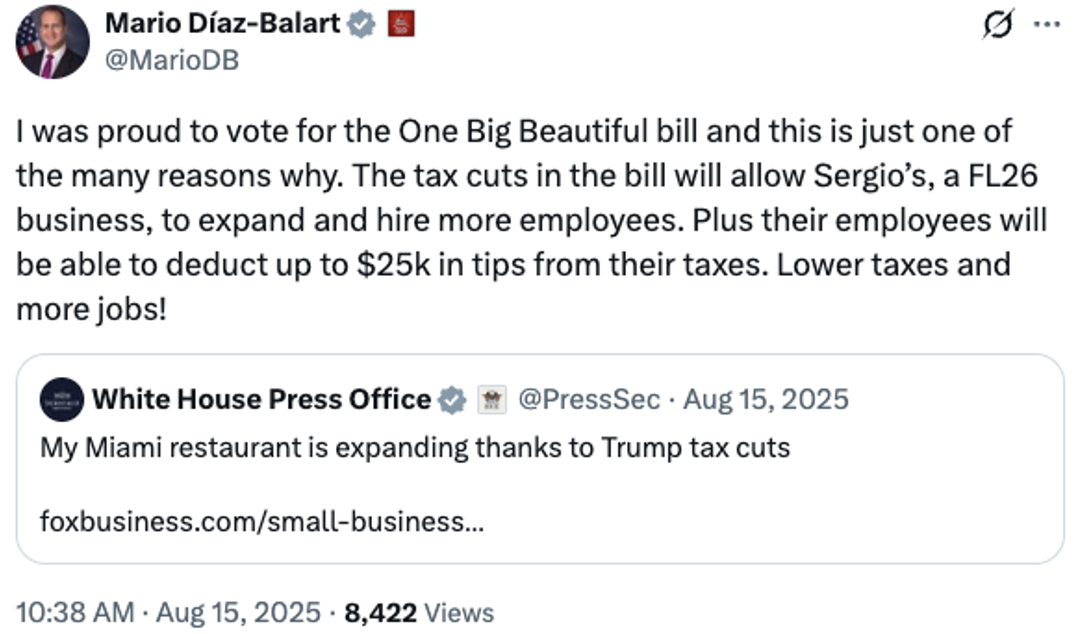
Diaz-Balart Said He Was “Proud” To Vote For The One Big Beautiful Bill For “Many Reasons.”
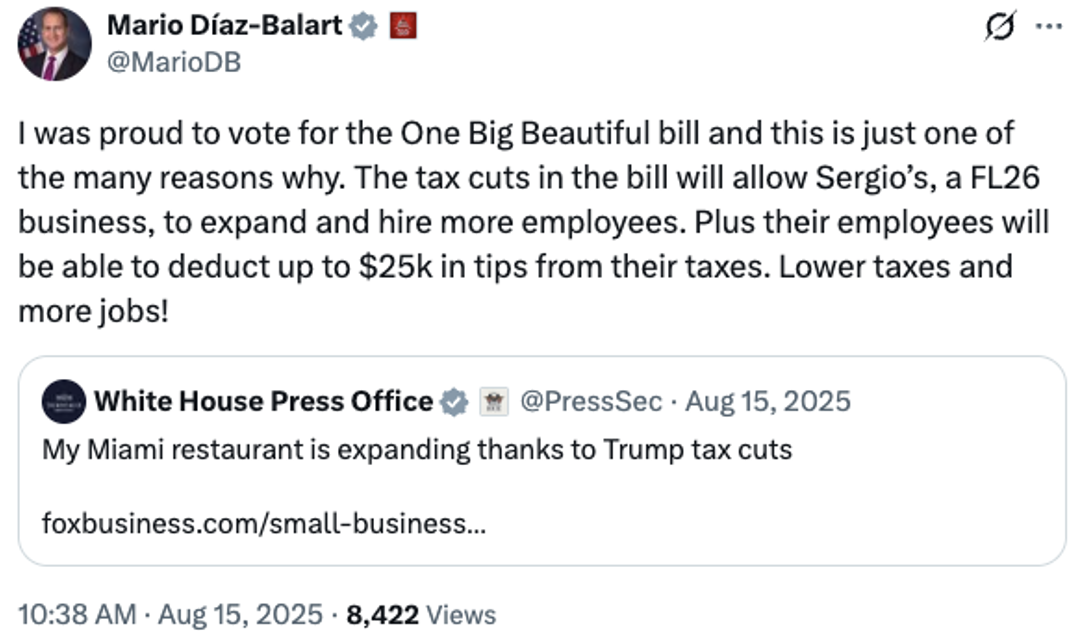
[Twitter, @MarioDB, 8/15/26]
¶ An Estimated 179,100 Floridians In The 26th Congressional District Relied On Medicaid Or CHIP For Health Insurance
2023: 179,100 Floridians In The 26th Congressional District Were Enrolled In Medicaid Or CHIP. According to the Center for American Progress,

[Center for American Progress, 3/11/25]
June 2025: The Joint Economic Committee Found That 127,162 Of Diaz-Balart’s Constituents Were Estimated To Lose Health Insurance Coverage As A Result Of The Republicans’ Cuts.
[Joint Economic Committee Minority, June 2025]
¶ Diaz-Balart Told Voters He Wanted To Strengthen Medicare, Then Voted For A Bill That Would Trigger Cuts To Medicare
¶ Diaz-Balart Claimed He Cared About Protecting Medicare
2025: Diaz-Balart Praised The Big Beautiful Bill Because He Believed It Protected Medicare. According to a "‘Once again, House Republicans are delivering on the mandate we promised to the American people under the leadership of President Trump by passing the ‘One, Big Beautiful Bill.’ This legislation responsibly reduces excess spending while protecting vital programs, such as Medicaid and Medicare benefits, for eligible Americans in need." [Press Release – Rep. Diaz-Balart, 5/22/25]
2016: Diaz-Balart Said “Saving Medicare” Was An Issue He Strongly Supported.” According to Florida Politics, "U.S. Rep. Mario Diaz-Balart was named a ‘Guardian of Seniors’ Rights’ and presented with an award Thursday from right-leaning retirement group the 60 Plus Association. ‘I’m grateful to receive this award from the 60 Plus Association. Preserving Social Security for current and future generations, saving Medicare, and repealing the estate and death taxes are important to our seniors, and these issues are ones that I strongly support,’ the Miami Republican said. ‘I have fought to protect the rights of seniors across Southern Florida, and will proudly continue to do so.’" [Florida Politics, 9/8/16]
2015: Diaz-Balart Claimed He Wanted To Strengthen Entitlement Programs Like Medicare To Protect Seniors’ Access To Healthcare. According to a press release from Rep. Mario Biaz-Balart, “As a budget conferee, I know how much hard work and dedication has been put into seeing that our national security and other vital programs are prioritized. House and Senate Republicans have come together to make the difficult decisions that need to be made and do what the people sent us to Washington for – to govern and create a balanced budget for a stronger America. By strengthening entitlement programs like Medicare and Social Security, it protects our seniors and their access to healthcare.” [Press Release – Rep. Mario Diaz-Balart, 4/30/15]
¶ 2025: Diaz-Balart Voted For The House Republican Reconciliation Bill, Which Would Trigger Nearly $500 Billion In Medicare Cuts
July 2025: Diaz-Balart Voted For The Senate FY 2025 Budget Reconciliation Bill That Extended $4 Trillion In Expiring Tax Cuts, Added New Tax Breaks, Appropriated $448 Million In Defense, Border, And Immigration Enforcement Funding, Increased The SALT Deduction To $40,000, And Cut Medicaid And Other Social Programs To Offset The Costs. In July 2025, Mario Diaz-Balart voted for, according to Congressional Quarterly, the “motion to concur in the Senate amendment to the bill that would permanently extend nearly $4 trillion in expiring individual and business tax cuts, create several new tax breaks and fund border and immigration enforcement and air traffic control upgrades. It would cut Medicaid and other safety net programs to partly offset the cost. Among other provisions, it would raise the statutory debt ceiling by $5 trillion and appropriate more than $448 billion in mandatory funding for Trump administration priorities and other needs, including $153 billion for defense, $89 billion for immigration enforcement, and $89.5 billion for border control and security. It also would increase the state and local tax deduction cap to $40,000 annually for five years for households making up to $500,000 a year until 2030, when it would permanently revert to $10,000.” The House passed the bill by a vote of 218 to 214. [House Vote 190, 7/3/25; Congressional Quarterly, 7/3/25; Congressional Actions, H.R. 1]
May 2025: Diaz-Balart Voted For The FY 2025 Budget Reconciliation Bill That Included $3.8 Trillion In Tax Cuts Offset By $1.5 Trillion In Spending Reductions To Programs Like Medicaid And The Supplemental Nutrition Assistance Program. In May 2025, Mario Diaz-Balart voted for, according to Congressional Quarterly, “the bill that would provide for approximately $3.8 trillion in net tax cuts and $321 billion in military, border enforcement and judiciary spending, offset by $1.5 trillion in spending reductions, as instructed in the fiscal 2025 budget resolution. It would raise the statutory debt limit by $4 trillion and provide for increased spending on defense and border security, spending cuts on social safety net programs, such as Medicaid and the Supplemental Nutrition Assistance Program. It also includes a mix of tax breaks for businesses and individuals; tax increases on universities and foundations; and a phase-down of clean energy tax credits. […] It would reduce federal spending on the Supplemental Nutrition Assistance Program by requiring states to shoulder more of the cost, expand work requirements for SNAP, extend programs authorized under the 2018 farm bill, and prohibit the U.S. Department of Agriculture from increasing the cost of the Thrifty Food Program. As amended, it would cap state and local tax deductions at $40,000 for households with incomes below $500,000.” The House passed the bill by a vote of 215 to 214. [House Vote 145, 5/22/25; Congressional Quarterly, 5/22/25; Congressional Actions, H.R. 1]