¶ Overview
Wilson embraced Trump’s tariffs and claimed they were improving the margins for the wood production industry in South Carolina. Then, he voted six times to protect the tariffs, including in April 2025 when he was the deciding vote to protect them, dooming South Carolina families who relied on him to a trade war and threatening to sink his state’s manufacturing industry. Tariffs are contributing to higher food prices, could raise car insurance rates and caused “mega-layoffs” across the nation.
¶ Wilson Supported Trump’s Detrimental Tariffs And Claimed Trump’s 2017 Tax Cuts “Worked”
¶ Wilson Has Repeatedly Voted To Protect Trump’s Tariffs
¶ February 2026: Wilson Voted To Protect Trump’s Tariffs
2026: Wilson Effectively Voted Against Terminating Tariffs On Canada. In February 2026, Wilson voted against, according to Congressional Quarterly, “the joint resolution that would terminate the Feb. 1, 2025, national emergency that imposed tariffs on goods from Canada.” The vote was on passage. The House passed the joint resolution by a vote of 219 to 211. [House Vote 65, 2/11/26; Congressional Quarterly, 2/11/26; Congressional Actions. H.J. Res. 72]
2026: Wilson Effectively Voted To Block Floor Votes On Terminating Tariffs Enacted Through Trump’s 2025 Executive Orders. In February 2026, Wilson voted for, according to Congressional Quarterly, “the rule (H Res 1042) providing for floor consideration of the Law-Enforcement Innovate to De-Escalate Act (HR 2189), the Undersea Cable Protection Act (HR 261), and the Securing America’s Critical Minerals Supply Act (HR 3617). […] It also would block the expedited consideration of joint resolutions terminating President Donald Trump's 2025 tariff actions under the Feb. 1, April 2, July 30, and Aug. 6 executive orders by providing that each day during the period from Feb. 10, 2026 through July 31, 2026, will not constitute a calendar day under the federal law pertaining to terminating national emergencies.” The vote was on the rule. The House rejected the rule by a vote of 214 to 217. [House Vote 60, 2/10/26; Congressional Quarterly, 2/10/26; Congressional Actions. H.Res. 1042]
- The Provision Was Added To A Rule Opening Debate On Three Unrelated Bills. According to Reuters, “Lawmakers voted 217-214 to derail the plan to bar tariff challenges through July 31, with three Republicans joining 214 Democrats in opposition. The prohibition was included in a measure intended to open debate on three unrelated bills.” [Reuters, 2/11/26]
- The House Adopted A Rule In March Of Last Year Barring Tariff Challenges That Expired In January Resulting In Speaker Johnson Calling Another Extension, Through This Rule, “Necessary.” According to Reuters, “Earlier in the day, Johnson told reporters that he expected the measure to pass the House, calling it necessary in view of an expected Supreme Court ruling on the legality of the tariffs. House Republicans first adopted a rule barring tariff challenges last March and later extended it through January.” [Reuters, 2/11/26]
- The Rule That Barred Tariffs Challenges Did Not Consider Days As “Calendar Days”, Blocking Democrats From Repealing Trump’s Declared National Emergency That Allowed For His Broad Tariffs. According to the Hill. “Trump declared national emergencies as a basis for implementing his broad-based global tariffs, as well as specific tariffs on China, Mexico and Canada. The National Emergencies Act dictates that Congress can use joint resolutions to repeal a national emergency, and outlines procedures to expedite that action after a certain number of calendar days. Multiple times last year, GOP leaders inserted language into procedural rule legislation to not count a ‘calendar day’ for the purposes of the National Emergencies Act until a specific date, blocking members from forcing action to repeal the tariffs. That prohibition expired at the end of January as GOP leaders faced resistance from Republicans. The latest attempt would have reinstated that prohibition until July 31, 2026.” [Reuters, 2/11/26]
- Johnson Delayed The Vote From 1:30 PM To 8:30 PM In An Attempt To Flip Votes. According to the Hill, “Speaker Mike Johnson (R-La.) was unable to win over the holdouts, despite delaying the vote from 1:30 p.m. to 8:30 p.m.” [Hill, 2/10/26]
¶ September 2025: Wilson Voted Again To Protect Trump’s Tariffs
2025: Wilson Effectively Voted For A Procedural Trick To Block Votes On The Reversal Of Trump’s Tariffs Through March 2026. In September 2025, Wilson voted for, according to Congressional Quarterly, “the resolution [that] would allow for the tolling (the pausing of counting) of days for resolutions of inquiry from Sept. 30, 2025 through March 31, 2026. It also would provide that each day during the period from April 9, 2025, through March 31, 2026. would not constitute a calendar day for the purposes of section 202 of the National Emergencies Act with respect to a joint resolution to terminate President Donald Trump's April 2, 2025 executive order declaring a national emergency regarding tariffs on imported goods. The resolution also would provide that during the period for March 11, 2025 through March 31, 2026, would not constitute a calendar day for purposes of section 202 of the National Emergencies Act with respect to a joint resolution terminating a national emergency executive order declared by President Trump on Feb. 1, 2025. Such an executive order concerned tariffs on many Canadian and Mexican imports and Chinese goods. The resolution also would provide that the provisions of section 202 of the National Emergencies Act would not apply through March 31, 2026 to a joint resolution terminating the national emergency.” The vote was on the rule. The House agreed to the rule by a vote of 213 to 211. [House Vote 268, 9/16/25; Congressional Quarterly, 9/16/25; Congressional Actions, H.Res. 707; Congressional Actions, H.Con. Res. 14]
- Support Was Won From GOP Holdouts Through A Promise Of A Vote Later In The Week To Shorten The Block To End In January Rather Than March. According to Politico, “GOP leaders flipped several of the Republican holdouts with a promise to add language shortening the block on tariff disapproval votes to a forthcoming measure set for approval later in the week, per two Republicans with direct knowledge of the agreement. The expiration date on the block will be reset from March 31 to the end of January, House Majority Leader Steve Scalise said Tuesday. It’s likely the Supreme Court will have ruled on a challenge to Trump’s tariff-declaring powers by then.” [Politico, 9/16/25]
- September 2025: House Republicans Voted In Favor Of A Measure That Effectively Blocked Challenges To Trump’s Tariffs Through March 2026, With The Intent Of Changing The Length Of Time To January 2026. According to Politico, "House Republicans voted in near lockstep Tuesday to again cede congressional power over tariffs to President Donald Trump. A measure that effectively blocks challenges to Trump’s sweeping global tariff declarations through March 2026 was adopted on a 213-211 vote. The vote was gaveled down only after GOP whips had a drawn-out struggle on the floor with a band of Republicans who initially opposed the legislation before flipping to yes. The vote was held open for more than a half-hour as they worked to bring the members back on board. GOP leaders flipped several of the Republican holdouts with a promise to add language shortening the block on tariff disapproval votes to a forthcoming measure set for approval later in the week, per two Republicans with direct knowledge of the agreement. The expiration date on the block will be reset from March 31 to the end of January, House Majority Leader Steve Scalise said Tuesday. It’s likely the Supreme Court will have ruled on a challenge to Trump’s tariff-declaring powers by then." [Politico, 9/16/25]
¶ April 2025: Wilson Cast The Deciding Vote To Protect Trump’s Tariffs
2025: Wilson Cast The Deciding Vote For A Procedural Trick To Block Votes On The Reversal Of Trump’s Tariffs Through September 2025. In April 2025, Wilson voted for, “adoption of the rule (H Res 313) that would provide for floor consideration of the Senate amendment to the fiscal 2025 budget resolution (H Con Res 14). The rule would provide up to one hour of debate on a motion to concur in the Senate amendment to the measure. It also would block the expedited consideration of joint resolutions terminating President Donald Trump’s tariff actions under the April 2 executive order by providing that each day during the period from April 9, 2025 through Sept. 30, 2025, will not constitute a calendar day under the federal law pertaining to terminating national emergencies.” The vote was on the rule. The underlying legislation was the FY 2025 budget resolution. The House agreed to the rule by a vote of 216 to 215. [House Vote 94, 4/9/25; Congressional Quarterly, 4/9/25; Congressional Actions, H.Res. 313; Congressional Actions, H.Con. Res. 14]
- Speaker Johnson Backed The Move, Claiming Trump Has “Executive Authority” And That The Tariffs Are “In The Interest Of The American People.” According to ABC News, “House Speaker Mike Johnson, R-La., defended the move, telling reporters, ‘I've made it very clear I think the president has executive authority. It's an appropriate level of authority to deal with the unfair trade practices. That's part of the role of the president is to negotiate with other countries.’ Johnson said Trump told him Tuesday night that ‘there are almost 70 countries that are [in] some stage in negotiation of more fair-trade agreement agreements with the United States. I think that is in the interest of the American people. I think that is an ‘America First’ policy that will be effective, and so we have to give them the space to do it.’” [ABC News, 4/9/25]
- The Vote Was The Second Use Of The Procedural Tactic To Block Votes On The Tariffs, The First Use Of It Being In March 2025. According to ABC News, “House Democrats, led by Rep. Gregory Meeks, D-N.Y., moved to force a vote on Tuesday on terminating the national emergency authority and blocking Trump's sweeping tariffs. Now, that vote is unlikely to occur. This is the second time Johnson has moved to stop the legislative calendar to prevent votes on Trump's authority on tariffs. Under House rules, these votes would typically come up within 15 calendar days but now will not if the ‘rule’ passes during the vote series Wednesday afternoon.” [ABC News, 4/9/25]
¶ If One “Aye” Vote Had Switched To A “No” On House Vote 94 The Measure Would Have Failed Instead Of Passing
The Measure Considered In House Vote 94 Passed By A Vote Of 216 “Ayes” To 215 “Nos,” Which Meant If One Aye Vote Had Switched To A No Vote The Measure Would Have Failed.
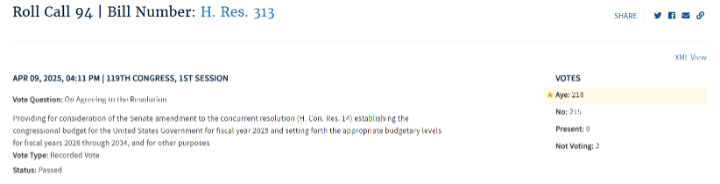
[House Vote 94, 4/9/25; Congressional Quarterly, 4/9/25; Congressional Actions, H.Res. 313;Congressional Actions, H.Con. Res. 14]
¶ April 2025: Wilson Voted To Protect Trump’s Tariffs
2025: Wilson Effectively Voted For A Procedural Trick To Block Votes On The Reversal Of Trump’s Tariffs Through September 2025. In April 2025, Wilson voted for, “motion to order the previous question (thus ending debate and possibility of amendment) on the rule (H Res 313) that would provide for floor consideration of the Senate amendment to the fiscal 2025 budget resolution (H Con Res 14). The rule would provide up to one hour of debate on a motion to concur in the Senate amendment to the measure. It also would block the expedited consideration of joint resolutions terminating President Donald Trump’s tariff actions under the April 2 executive order by providing that each day during the period from April 9, 2025 through Sept. 30, 2025, will not constitute a calendar day under the federal law pertaining to terminating national emergencies.” The vote was on the previous question. The House agreed to the rule by a vote of 217 to 212. [House Vote 93, 4/9/25; Congressional Quarterly, 4/9/25; Congressional Actions, H.Res. 313]
¶ March 2025: Wilson Voted To Protect Trump’s Tariffs
2025: Wilson Voted To Disapprove An IRS Rule That Established Reporting Requirements For Digital Asset Proceeds And To Effectively Block Votes On The Reversal Of Trump’s Tariffs. In March 2025, Wilson voted for, “the bill that would provide for Congressional disapproval of, and nullify, a December 2024 IRS rule related to gross proceeds reporting by brokers involved in digital asset sales. The rule imposed reporting requirements, beginning in 2027, on non-custodial brokers who participate in the decentralized digital asset market. It also required brokers to file information returns and provide payee statements reporting gross proceeds from certain digital asset sales and transactions.” The vote was on passage. The House passed the bill by a vote of 292 to 132. [House Vote 71, 3/11/25; Congressional Quarterly, 3/11/25; Congressional Actions, H.J. Res. 25]
- The Bill Effectively Blocked The House From Voting To Reverse Trump’s Tariffs On Mexico, Canada, And China For The Next Year. According to the New York Times, “Republican leaders on Tuesday slipped language into a procedural measure that would prevent any resolution to end the tariffs on Mexico, Canada and China from receiving a vote this year. It passed on party lines as part of a resolution that cleared the way for a vote later Tuesday on a government spending bill needed to prevent a shutdown at the end of the week.” [New York Times, 3/11/25]
- The Bill Nullified A Law That Would Allow The House And Senate To End A Disaster Declared By The President. According to the New York Times, “In this case, Republican leaders did so using a particularly unusual contortion: They essentially declared the rest of the year one long day, nullifying a law that allows the House and Senate to jointly put an end to a disaster declared by the president.” [New York Times, 3/11/25]
- The National Emergencies Act Required Consideration Of Resolutions Ending A Presidentially Declared Emergency Within Fifteen Calendar Days But Republican Leadership Included A Measure In The Bill Declaring The Rest Of The Year Did Not Constitute A Calendar Day. According to the New York Times, “The national emergency law lays out a fast-track process for Congress to consider a resolution ending a presidential emergency, requiring committee consideration within 15 calendar days after one is introduced and a floor vote within three days after that. But the language House Republicans inserted in their measure on Tuesday declared that, ‘Each day for the remainder of the 119th Congress shall not constitute a calendar day’ for the purposes of the emergency that Mr. Trump declared on Feb. 1.” [New York Times, 3/11/25]
¶ Wilson Embraced Trump’s Tariffs And Urged HIm To Expand The number Of Impacted Industries
Wilson Urged Trump To Broaden His Tariffs To Include On Products Made of Wood In Order To Benefit South Carolina Wood Producers. According to Bloomberg, “Congressional Republicans are embracing Donald Trump’s tariff campaign as a way to advance home-state causes, lobbying the president to impose more import duties to protect local companies. The rank-and-file GOP lawmakers’ entreaties, which often present trade actions shoring up favored manufacturers as a winning tactic for midterm elections, bolster the political case for broadening US tariffs. […] Republican Representative Joe Wilson of South Carolina and Republican Senator Katie Britt of Alabama are among other lawmakers pushing for tariffs on products made of wood. Some local manufacturers in their states want a duty of at least 100% on cabinets.” [Bloomberg, 8/23/25]
Wilson Praised Trump’s Tariffs On Steel And Aluminum As A Boon For The Wood Production Industry. According to WYMT, “Rep. Joe Wilson (R-S.C.), said wood producers could benefit from the specific tariffs Trump has already levied on steel and aluminum. ‘In the district I represent I’ve had steel and aluminum manufacturers. I have been the director of the steel caucus in the past, and I’ve seen how it can change.’ Wilson said when it comes to Chinese manufacturing and America, it’s not just about jobs, it’s about national security. ‘They have a policy of military-civilian fusion. And that is that all of their companies could, in the event of a war, immediately convert into the production of military equipment.’” [WYMT, 7/16/25]
¶ Trump’s Tariffs Were Causing “Mega-Layoffs” Across The Country And Threatened To Sink South Carolina’s Manufacturing Industry
October 2025: Employers Cut 153,000 Jobs In A Series Of “Mega-Layoffs.” According to Common Dreams, “As reported by the Washington Post on Thursday, new data from corporate outplacement firm Challenger, Gray & Christmas found that employers in October announced 153,000 job cuts, which marked the highest number of layoffs in that month since October 2003. Total announced job cuts in 2025 have now reached 1.1 million, a number that the Post describes as a ‘recession-like’ level comparable to the steep job cuts announced in the wake of the dotcom bust of the early 2000s, the global financial crisis of 2008, and the onset of the Covid-19 pandemic in 2020. John Challenger, the CEO of Challenger, Gray & Christmas, told the Post that the huge number of October layoffs showed the economy was entering ‘new territory.’ ‘We haven’t seen mega-layoffs of the size that are being discussed now—48,000 from UPS, potentially 30,000 from Amazon—since 2020 and before that, since the recession of 2009,’ he explained. ‘When you see companies making cuts of this size, it does signal a real shift in direction.’” [Common Dreams, 11/6/25]
- Corporations Cited Trump’s Tariffs As A Reason For The Layoffs. According to Common Dreams, “According to Bloomberg, however, AI adoption is just one factor in companies’ decision to enact mass layoffs, as some firms have also cited the need to protect their profit margins from the impacts of President Donald Trump’s tariffs, which have raised prices for a wide variety of products and materials.” [Common Dreams, 11/6/25]
Trump’s Tariffs Threatened To Sink South Carolina’s Manufacturing Industry, Which Was Spearheaded By Foreign Companies. According to the New York Times, “The Upstate region of South Carolina was saved by foreign companies after the fall of its textile industry. Now, tariffs pose another round of uncertainty. […] Since taking office, Mr. Trump has imposed and suspended tariffs on imports at breakneck speed, with the goal of forcing companies to bring manufacturing back to the United States. This week, he abruptly paused reciprocal tariffs for the next three months on some of America's largest trading partners, dropping levels to a universal 10 percent, while exponentially raising tariffs on Chinese exports (though on Friday night he appeared to exempt many electronics like smartphones from most of those punishing tariffs on China). But Mr. Trump's goals have clashed with the current economic reality in places like Spartanburg and Greenville, S.C., heavily Republican areas where foreign companies have turned the onetime textile hubs into wealthy, industrial heavyweights. Should those levies go back into effect, locals worry that they will threaten the very businesses that saved the region, home to some 1.5 million residents, all to revive a bygone industry that few people miss.” [New York Times, 4/14/25]
- Local Businesses In South Carolina Said There Was “Widespread Bewilderment” In Response To How Trump’s Cabinet Spoke About BMW And Mercedes, The Very Companies That Propped Up Much Of South Carolina’s Economy. According to the New York Times, “So the local business community was stunned when the White House's top trade adviser, Peter Navarro, attacked BMW's manufacturing process in an interview this week. He told CNBC on Monday that ‘this business model where BMW and Mercedes come into Spartanburg, S.C., and have us assemble German engines and Austrian transmissions - that doesn't work for America. It's bad for our economics. It's bad for our national security.’ ‘There was widespread bewilderment in our community about that,’ said Carlos Phillips, the president and chief executive of the Greenville Chamber of Commerce. In response to Mr. Navarro's comments, South Carolina's governor, Henry McMaster, told reporters this week that ever since BMW arrived in the state with well-paying jobs, other companies had followed suit and ‘sent the word out around the world that this is a great manufacturing state.’” [New York Times, 4/14/25]
- Trump’s Tariffs Threatened To Halt Investment And Threaten Existing Jobs In South Carolina’s Manufacturing Industry. According to the New York Times, “Now, leaders say that waging a trade war could undermine future recruitment of international investments and risk losing the jobs that are already in the region. If tariffs raise prices on products and BMW's sales drastically drop, they said, there's a higher chance of layoffs at the Spartanburg plant. And it is difficult to imagine how cheap fabric or yarn manufacturing, the kind made in factories in Vietnam, Cambodia and China, could meaningfully fill the gaps, they added.” [New York Times, 4/14/25]
According To A Report From The Scholars Strategy Network, Trump’s “Liberation Day” Tariffs Threatened To Disrupt Much Of South Carolina’s Manufacturing Industries. According to the Scholars Strategy Network, “South Carolina's manufacturing sector is a cornerstone of the state's economy. Residents benefit from the jobs and technology brought by our state’s manufacturing firms. However, this economic powerhouse is facing significant challenges due to the recently announced ‘Liberation Day’ tariffs by the Trump Administration. These tariffs, aimed at reshaping international trade dynamics, threaten to disrupt the state's robust manufacturing industries, particularly automotive and aerospace, which are heavily integrated into global supply chains. These tariffs are harmful to the South Carolina economy, are unlikely to accomplish many of the goals that the Trump Administration identifies as justifying the tariffs, and will undermine a liberal, rules-based order that the U.S. and allies painstakingly constructed in the years after World War II. While the overall effect will be harmful both domestically and internationally, South Carolina policy leaders must advocate for certain policies to mitigate the worst effects of the tariffs.” [Scholars Strategy Network, 6/20/25]
Trump’s Tariffs Disrupted Business At South Carolina’s Port Of Charleston. According to the South Carolina Daily Gazette, “President Donald Trump’s erratic tariff policies are roiling global trade, forcing South Carolina businesses and nearly every sector of the state’s logistics network to question where they go from here. ‘It was like stopping a Ferris Wheel, and you’re sitting at the top,’ maritime industry analyst Jim Newsome, former president of the S.C. State Ports Authority, said of the frozen future many industries are facing since Trump’s ‘Liberation Day’ tariff announcements on April 2. ‘Everybody is bracing for the impact,’ he said.” [South Carolina Daily Gazette, 5/9/25]
- The Port Of Charleston Was Bracing For A Noticeable Drop In Cargo If The Tariff Policy Did Not Change. According to the South Carolina Daily Gazette, “Year-over-year cargo levels measured by the equivalent of 20-foot-long containers — or TEUs in maritime jargon — moving through Charleston’s terminals have held steady or even increased this spring as retailers and others frontloaded shipments ahead of the tariffs. That’s about to change, analysts say, because cargo that takes weeks to arrive along the East Coast will now be hit with the tariffs. By June, ports in Charleston, Savannah and along the East Coast could see noticeable drops in cargo if tariff policies don’t change. On average, about half of the freight bound for Charleston’s port either originates in or has major stops in China, which reported Friday that April shipments to the U.S. dropped by 21%. Ocean liners in recent weeks have canceled about 17% of the container ships scheduled to travel to East Coast ports because of cargo shortages, according to Copenhagen-based maritime research group Sea-Intelligence.” [South Carolina Daily Gazette, 5/9/25]
¶ Wilson Supported The Extension Of Trump’s 2017 Tax Cuts And Claimed They Resulted In “Huge Savings”
November 2017: Wilson Touted His Vote For The Tax Cuts And Jobs Act, Claiming That It “Lowers Tax Rates For Everyday Americans.” Rep. Joe Wilson tweeted, “After months of talking about tax cuts, the American people wanted Congress to take action. That’s exactly what Republicans have done.”
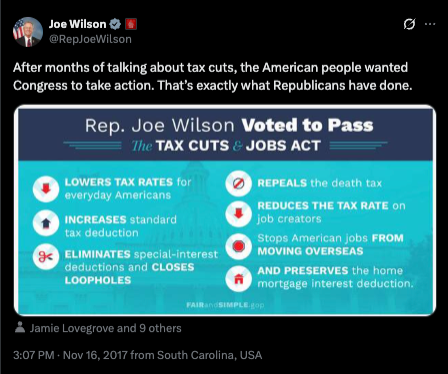
[Twitter, @RepJoeWilson, 11/16/17]
January 2018: Wilson Touted The 2017 Tax Cuts And Jobs Act On The House Floor. Rep. Joe Wilson tweeted, “This afternoon, I had the opportunity to share some of the positive impacts of the Tax Cuts and Jobs Act. See my remarks in the House today:”

[Twitter, @RepJoeWilson, 1/10/28] (video)
February 2019: Wilson Claimed Trump’s Tax Cuts Created 4 Million Jobs. Rep. Joe Wilson tweeted, “In his #SOTU speech, @RealDonaldTrump outlined key priorities for South Carolina & the American people. With President Trump’s tax cuts, over 4 million jobs have been created, including an outstanding report showing 304,000 jobs being added in January.”

[Twitter, @RepJoeWilson, 2/5/19]
January 2026: Wilson Claimed Trump’s 2017 Tax Cuts “Worked.” Rep. Joe Wilson tweeted, “I spoke on the House floor about how the Working Families Tax Cuts law cuts taxes, limits government, expands freedom, and provides pro-growth policies that will create jobs. Under @POTUS the Tax Cuts and Jobs Act of 2017 worked, but it had an expiration date at the end of 2025 -- and Americans would have faced an historic tax increase. This Republican law enables families and businesses to make long-term plans with confidence, creating jobs.”

[Twitter, @RepJoeWilson, 1/12/26]
2024: According To The Center On Budget And Policy Priorities, Trump’s 2017 Tax Cuts Disproportionally Favored The Wealthy. According to a report from the Center on Budget and Policy Priorities, “As this debate unfolds, policymakers and the public should understand that the 2017 Trump tax law: Was skewed to the rich. Households with incomes in the top 1 percent will receive an average tax cut of more than $60,000 in 2025, compared to an average tax cut of less than $500 for households in the bottom 60 percent, according to the Tax Policy Center (TPC). As a share of after-tax income, tax cuts at the top — for both households in the top 1 percent and the top 5 percent — are more than triple the total value of the tax cuts received for people with incomes in the bottom 60 percent.” [Report – Center on Budget and Policy Priorities, 6/13/24]
- The 2017 Trump Tax Cuts Failed To Deliver The Boost To Household Income That Republicans Promised They Would. According to a report from the Center on Budget and Policy Priorities, “As this debate unfolds, policymakers and the public should understand that the 2017 Trump tax law: […] Failed to deliver promised economic benefits. Trump Administration officials claimed their centerpiece corporate tax rate cut would ‘very conservatively’ lead to a $4,000 boost in household income. New research shows that workers who earned less than about $114,000 on average in 2016 saw ‘no change in earnings’ from the corporate tax rate cut, while top executive salaries increased sharply. Similarly, rigorous research concluded that the tax law’s 20 percent pass-through deduction, which was skewed in favor of wealthy business owners, has largely failed to trickle down to workers in those companies who aren’t owners. Like the Bush tax cuts before it, the 2017 Trump tax cut was a trickle-down failure.” [Report – Center on Budget and Policy Priorities, 6/13/24]