¶ Greg Murphy – Key Votes
¶ Murphy Voted To Threaten The Health Care Of More Than 46,000 North Carolinians In His District
According To The Joint Economic Committee, More Than 46,000 North Carolinians Were At Risk Of Losing Their Health Insurance As A Result Of Republicans' Reconciliation Bill. [Joint Economic Committee, June 2025]
¶ July 2025: Murphy Voted For The Final Version Of Republicans’ Reconciliation Bill
7/3/25: Murphy Voted For The Senate FY 2025 Budget Reconciliation Bill That Cut Medicaid And Other Social Programs To Offset The Bill’s Costs. In July 2025, Murphy voted for, according to Congressional Quarterly, the “motion to concur in the Senate amendment to the bill that would permanently extend nearly $4 trillion in expiring individual and business tax cuts, create several new tax breaks and fund border and immigration enforcement and air traffic control upgrades. It would cut Medicaid and other safety net programs to partly offset the cost. Among other provisions, it would raise the statutory debt ceiling by $5 trillion and appropriate more than $448 billion in mandatory funding for Trump administration priorities and other needs, including $153 billion for defense, $89 billion for immigration enforcement, and $89.5 billion for border control and security. It also would increase the state and local tax deduction cap to $40,000 annually for five years for households making up to $500,000 a year until 2030, when it would permanently revert to $10,000.” The House passed the bill by a vote of 218 to 214. [House Vote 190, 7/3/25; Congressional Quarterly, 7/3/25; Congressional Actions, H.R. 1]
- HEADLINE: "At Least 17 Million Americans Would Lose Insurance Under Trump Plan" [Washington Post, 7/1/25]
- The Congressional Budget Office Estimated That 11.8 Million People Would Become Uninsured As A Result Of The Medicaid Cuts In Republicans’ Reconciliation Bill. According to the Washington Post, "The bill, which narrowly passed the Senate on Tuesday and now heads back to the House, would effectively accomplish what Republicans have long failed to do: unwind many of the key components of the ACA, President Barack Obama’s signature domestic achievement, which dramatically increased the number of Americans with access to health insurance. To start, the Congressional Budget Office estimated that the Senate version of the bill would result in 11.8 million more uninsured in 2034, mostly because of Medicaid cuts, compared with 10.9 million if the House version became law." [Washington Post, 7/1/25]
¶ May 2025: Murphy Voted For House Republicans’ Budget Bill, Which Would Kick Millions Of People Off Medicaid
5/22/25: Murphy Voted For The FY 2025 Budget Reconciliation Bill That Included $3.8 Trillion In Tax Cuts Offset By $1.5 Trillion In Spending Reductions To Programs Like Medicaid And The Supplemental Nutrition Assistance Program. In May 2025, Murphy voted for, according to Congressional Quarterly, “the bill that would provide for approximately $3.8 trillion in net tax cuts and $321 billion in military, border enforcement and judiciary spending, offset by $1.5 trillion in spending reductions, as instructed in the fiscal 2025 budget resolution (H Con Res 14). It would raise the statutory debt limit by $4 trillion and provide for increased spending on defense and border security, spending cuts on social safety net programs, such as Medicaid and the Supplemental Nutrition Assistance Program. It also includes a mix of tax breaks for businesses and individuals; tax increases on universities and foundations; and a phase-down of clean energy tax credits. […] It would reduce federal spending on the Supplemental Nutrition Assistance Program by requiring states to shoulder more of the cost, expand work requirements for SNAP, extend programs authorized under the 2018 farm bill, and prohibit the U.S. Department of Agriculture from increasing the cost of the Thrifty Food Program. As amended, it would cap state and local tax deductions at $40,000 for households with incomes below $500,000.” The House passed the bill by a vote of 215 to 214. [House Vote 145, 5/22/25; Congressional Quarterly, 5/22/25; Congressional Actions, H.R. 1]
- The House GOP Budget Bill Was Estimated To Increase The Uninsured Population By 8.6 Million By 2034. According to CNN, “The Medicaid and Affordable Care Act provisions in the package could result in 8.6 million more people being uninsured in 2034, according to an early CBO estimate released by Democratic lawmakers. That number is expected to grow with the latest changes.” [CNN, 5/28/25]
- The House GOP Budget Bill Codified A Trump Administration Proposal That Restricted Access To The Affordable Care Act. According to CNN, “The bill also calls for codifying a Trump administration proposal that would make changes to the Affordable Care Act enrollment process, including shortening the open enrollment period and eliminating the ability of low-income Americans to sign up year-round.” [CNN, 5/28/25]
¶ February 2025: Murphy Voted For A Budget Resolution That Spelled Out Future Medicaid Cuts
2/25/25: Murphy Voted For The FY 2025 Budget Framework That Included $2 Trillion In Cuts, Raised The Statutory Debt Limit By $4 Trillion, And Required House Committees To Recommend Legislation That Would Implement Trump’s Agenda. In February 2025, Murphy voted for, according to Congressional Quarterly, “the concurrent resolution that would recommend a budget for fiscal 2025 and budget levels through fiscal 2034. The resolution would assume minimum savings of $1.5 trillion over 10 years and 2.6 percent economic growth over the same period. It also would require the statutory debt limit to be raised by $4 trillion. It also would authorize the House Ways and Means Committee to increase deficits by $4.5 trillion over 10 years to extend the 2017 tax cuts and implement new tax cuts proposed by the White House. It also would provide instructions for the budget reconciliation process through which separate legislation could be considered and passed in the Senate via a simple majority vote. The measure would deliver instructions to 11 House committees to report legislation that would implement President Donald Trump’s agenda, such as expanding tax cuts and bolstering border security and immigration enforcement. The committees would be required to report their legislative recommendations to the House Budget Committee by March 27, 2025. It also would set a $2 trillion target for the spending cuts to be submitted to the House Budget Committee. The resolution also would stipulate that if the committees don't reach that target, the Ways and Means’ reconciliation instructions to increase the deficit by a maximum of $4.5 trillion would be decreased by the amount the other committees come in below the target. Similarly, it would stipulate that Ways and Means could increase the deficit above the $4.5 trillion level by the amount of savings the committees achieve above the $2 trillion target.” The vote was on passage. The House passed the resolution by a vote of 217 to 215. [House Vote 50, 2/25/25; Congressional Quarterly, 2/25/25; Congressional Actions, H. Con. Res. 14]
- HEADLINE: “What Can House Republicans Cut Instead Of Medicaid? Not Much.” [New York Times, 2/25/25]
- HEADLINE: "House Republican Budget Takes Away Health Care, Food Aid To Pay For Expanded Tax Cuts For Wealthy" [Center on Budget and Policy Priorities, 2/21/25]
- New York Times Reported The $880 Billion In Cuts Required By The Republican Budget Proposal Would Have To Come From Medicaid, Medicare, Or CHIP. According to the New York Times, "The budget resolution itself is silent on whether Congress cuts Medicaid, which provides health coverage to 72 million poor and disabled Americans. But it instructs the House Energy and Commerce Committee, which has jurisdiction over the program, to cut spending by $880 billion over the next decade. If the committee can’t save at least that much, the entire effort could be imperiled because of the special process Congress is using to avoid a Senate filibuster. Ten other committees have their own instructions to follow, though none have been assigned with cutting nearly as much. It’s not so simple as finding the cuts elsewhere. The special process, known as budget reconciliation, means Republicans will have to find all $880 billion from within the Energy and Commerce Committee’s jurisdiction. That leaves them with fewer options than one might think. […] If Republicans want to avoid major cuts to Medicaid, the largest pot of available money is in the other big government health insurance program: Medicare. […] Even if the committee cuts everything that’s not health care to $0, it will still be more than $600 billion short. The committee could also save around $200 billion by eliminating the Children’s Health Insurance Program, but that option has not been raised by the budget committee or anyone in House leadership. […] Even if all of these cuts, revenues and rule cancellations from outside health care can pass muster, the committee will still be left with hundreds of billions of dollars to cut to hit its goal. Mathematically, the budget committee’s instructions mean the committee would need to make major cuts to either Medicare, Medicaid or both." [New York Times, 2/25/25]
¶ 2025: Murphy Voted In Favor Of The House Republican budget Bill That Would Trigger Major Cuts To Medicare, absent future congressional action
May 2025: Murphy Voted For The FY 2025 Budget Reconciliation Bill That Included $3.8 Trillion In Tax Cuts Offset By $1.5 Trillion In Spending Reductions To Programs Like Medicaid And The Supplemental Nutrition Assistance Program. In May 2025, Murphy voted for, according to Congressional Quarterly, “the bill that would provide for approximately $3.8 trillion in net tax cuts and $321 billion in military, border enforcement and judiciary spending, offset by $1.5 trillion in spending reductions, as instructed in the fiscal 2025 budget resolution (H Con Res 14). It would raise the statutory debt limit by $4 trillion and provide for increased spending on defense and border security, spending cuts on social safety net programs, such as Medicaid and the Supplemental Nutrition Assistance Program. It also includes a mix of tax breaks for businesses and individuals; tax increases on universities and foundations; and a phase-down of clean energy tax credits. […] It would reduce federal spending on the Supplemental Nutrition Assistance Program by requiring states to shoulder more of the cost, expand work requirements for SNAP, extend programs authorized under the 2018 farm bill, and prohibit the U.S. Department of Agriculture from increasing the cost of the Thrifty Food Program. As amended, it would cap state and local tax deductions at $40,000 for households with incomes below $500,000.” The House passed the bill by a vote of 215 to 214. [House Vote 145, 5/22/25; Congressional Quarterly, 5/22/25; Congressional Actions, H.R. 1]
- HEADLINE: "Trump And GOP’s Tax Bill Would Force Cuts To Medicare, CBO Says" [Washington Post, 5/21/25]
- Congressional Budget Office Estimated That The House Republican Reconciliation Bill Would Trigger Nearly $500 Billion In Cuts To Medicare. According to a letter the Congressional Budget Office sent to Rep. Brendan Boyle, "Today the Congressional Budget Office transmitted an estimate of the budgetary effects of the 2025 reconciliation bill, as ordered reported by the House Committee on the Budget on May 18, 2025. 1 CBO has not yet completed estimates of the effects of interactions among the titles of the legislation. This letter responds to your questions concerning the sequestration (the cancellation of budgetary resources) in accordance with the Statutory Pay‑As‑You‑Go Act of 2010 (S-PAYGO) that would occur if an enacted bill raised deficits by $2.3 trillion over 10 years. Under S-PAYGO, the Office of Management and Budget (OMB) is required to maintain 5- and 10-year scorecards that it updates with the estimated cumulative changes in revenues and outlays generated by newly enacted legislation. […] The 4 percent maximum reduction in Medicare spending would apply to sequestration orders for years after 2026. If OMB ordered a sequestration of $230 billion for each year through 2034, the ordered reductions in Medicare spending would increase to about $75 billion in 2034 and would total roughly $490 billion over the 2027–2034 period." [Letter to Rep. Brendan Boyle – Congressional Budget Office, 5/20/25]
July 2025: Murphy Voted For The Senate FY 2025 Budget Reconciliation Bill That Extended $4 Trillion In Expiring Tax Cuts, Added New Tax Breaks, Appropriated $448 Billion In Defense, Border, And Immigration Enforcement Funding, Increased The SALT Deduction To $40,000, And Cut Medicaid And Other Social Programs To Offset The Costs. In July 2025, Murphy voted for, according to Congressional Quarterly, the “motion to concur in the Senate amendment to the bill that would permanently extend nearly $4 trillion in expiring individual and business tax cuts, create several new tax breaks and fund border and immigration enforcement and air traffic control upgrades. It would cut Medicaid and other safety net programs to partly offset the cost. Among other provisions, it would raise the statutory debt ceiling by $5 trillion and appropriate more than $448 billion in mandatory funding for Trump administration priorities and other needs, including $153 billion for defense, $89 billion for immigration enforcement, and $89.5 billion for border control and security. It also would increase the state and local tax deduction cap to $40,000 annually for five years for households making up to $500,000 a year until 2030, when it would permanently revert to $10,000.” The House passed the bill by a vote of 218 to 214. [House Vote 190, 7/3/25; Congressional Quarterly, 7/3/25; Congressional Actions, H.R. 1]
¶ Murphy Voted Against Cheaper Prescription Drugs for North Carolina Seniors
¶ 2022: Murphy Voted Against The Inflation Reduction Act
August 2022: Murphy Voted Against The Inflation Reduction Act. In August 2022, according to Congressional Quarterly, Murphy voted against concurring in the Senate amendment to the Inflation Reduction Act of 2022, “comprising a package of climate, tax and health care provisions.” The vote was on a motion to concur. The House concurred with the Senate by a vote 220-207, thus the bill was sent to President Biden for final signage. President Biden signed the bill and it ultimately became law. [House Vote 420, 8/12/22; Congressional Quarterly, 8/12/22; Congressional Actions, H.R. 5376]
- The Inflation Reduction Act Allowed Medicare To Negotiate Prices For Certain Prescription Drugs. According to the U.S. Department of Health and Human Services, "Negotiations are underway between HHS and the participating drug companies of the first 10 prescription drugs selected for negotiation in the first cycle of the Medicare Drug Price Negotiation Program. The first 10 drugs selected treat conditions such as blood clots, diabetes, heart disease, heart failure, autoimmune diseases, and chronic kidney disease." [U.S. Health and Human Services, Inflation Reduction Act Of 2022, Viewed 7/1/24]
- The Inflation Reduction Act Required Drug Companies To Pay A Rebate To Medicare If They Raised Prices Faster Than The Rate Of Inflation. According to the U.S. Department of Health and Human Services, "Allowing Medicare to negotiate with participating drug companies to get lower drug prices for certain drugs covered under Medicare Beginning negotiations with the participating drug companies that manufacture all 10 drugs selected for the first cycle of negotiations" [U.S. Health and Human Services, Inflation Reduction Act Of 2022, Viewed 7/1/24]
¶ Murphy Voted Against Capping The Cost Of Insulin At $35 Per Month
2022: Murphy Voted Against The Affordable Insulin Now Act, Which Required Private Insurances And Medicare To Cover Certain Insulin Products, Prohibit Deductibles For Insulin, And Cap Cost-Sharing For Such Insulin Products Beginning In 2023. In March 2022, according to Congressional Quarterly, Murphy voted against the Affordable Insulin Now Act, which would “require private health insurance and Medicare to cover certain insulin products and limit cost-sharing requirements for such products for plans beginning in 2023. Specifically, it would require private insurance plans to cover at least one of each dosage form of each type of insulin, such as short-acting, long-acting and premixed insulin; prohibit the plans from applying a deductible for the insulin products; and cap cost-sharing for the insulin products at the lesser of $35 or 25 percent of the plan's negotiated price for the product per 30-day supply. For Medicare plans, it would similarly prohibit the application of a deductible for covered insulin products and cap copayments at $35 per 30-day supply.” The vote was on passage. The House passed the bill by a vote of 232-193, thus the bill was sent to the Senate. The bill was passed by the Senate and both chambers are resolving differences. The bill was turned into the Continuing Appropriations and Ukraine Supplemental Appropriations Act, 2023 and that version ultimately became law. [House Vote 102, 3/31/22; Congressional Quarterly, 3/31/22; Congressional Actions, H.R. 6833]
- The Measure Would Cap Insulin Costs At Either $35 Per Month Or 25% Of A Health Insurance Plan’s Negotiated Costs Beginning In 2023. According to NPR, “The Affordable Insulin Now Act would cap insulin prices at either $35 a month or 25% of an insurance plan’s negotiated price — whichever is lower. The legislation would take effect in 2023 but its fate in the Senate remains unclear.” [NPR, 3/31/22]
- According To The Health Care Cost Institute, Insulin Prices Doubled Between 2012 And 2016. According to NPR, “Advocates of the legislation point to data from the Health Care Cost Institute, an independent nonprofit that studies health care prices, which shows prices for insulin doubled between 2012 and 2016.” [NPR, 3/31/22]
¶ 2019: Murphy voted against allowing medicare to negotiate lower prescription drug costs
2019: Murphy Voted Against The House Drug Price Negotiation Bill For Medicare Programs. In December 2019, Murphy voted against a motion that would, according to Congressional Quarterly, “allow the Health and Human Services Department to negotiate prices for certain drugs under Medicare programs and would make a number of modifications to Medicare programs related to drug costs and plan benefits.” The vote was on passage. The House passed the bill by a vote of 230-192. [House Vote 682, 12/12/19; Congressional Quarterly, 12/12/19; Congressional Actions, H.R.3]
- The Bill Allowed HHS To Negotiate The Prices Of Prescription Drugs Covered By Medicare And Penalize Companies That Don’t Comply. According to Vox, “Under current law, the Health and Human Services secretary is barred from engaging in negotiations for prescription drugs covered by Medicare […] The final bill enables the HHS secretary to negotiate the prices of as many as 250 drugs annually. Additionally, it would penalize companies that do not negotiate with HHS with a fine starting at 65 percent of a drug’s gross sales from the prior year. For every quarter that the company does not engage, the penalty goes up by 10 percentage points, until it hits 95 percent of a drug’s gross sales.” [Vox, 12/12/19]
The Bill Required Drugmakers To Issue Rebates To The Treasury If They Raised The Prices For Medicare Drugs Faster Than The Rate Of Inflation. According to Vox, “The proposal would also address pricing hikes that have been applied to different drugs covered by Medicare Parts B and D, requiring companies to either undo any increases that surpass the rate of inflation, or rebate the entirety of those hikes since 2016 to the Treasury. An amendment from Jayapal would also make sure that people covered by private plans could obtain rebates as well. Additionally, the bill would cap out-of-pocket prescription drugs costs for those covered by Medicare Part D to $2,000 annually. Currently, there is no cap.” [Vox, 12/12/19]
¶ Murphy Was The Deciding Vote To Protect Trump’s Tariffs
¶ Murphy repeatedly voted to protect trump’s tariffs
¶ September 2025: Murphy Voted To Protect Trump’s Tariffs
2025: Murphy Effectively Voted For A Procedural Trick To Block Votes On The Reversal Of Trump’s Tariffs Through March 2026. In September 2025, Murphy voted for, according to Congressional Quarterly, “the resolution [that] would allow for the tolling (the pausing of counting) of days for resolutions of inquiry from Sept. 30, 2025 through March 31, 2026. It also would provide that each day during the period from April 9, 2025, through March 31, 2026. would not constitute a calendar day for the purposes of section 202 of the National Emergencies Act with respect to a joint resolution to terminate President Donald Trump's April 2, 2025 executive order declaring a national emergency regarding tariffs on imported goods. The resolution also would provide that during the period for March 11, 2025 through March 31, 2026, would not constitute a calendar day for purposes of section 202 of the National Emergencies Act with respect to a joint resolution terminating a national emergency executive order declared by President Trump on Feb. 1, 2025. Such an executive order concerned tariffs on many Canadian and Mexican imports and Chinese goods. The resolution also would provide that the provisions of section 202 of the National Emergencies Act would not apply through March 31, 2026 to a joint resolution terminating the national emergency.” The vote was on the rule. The House agreed to the rule by a vote of 213 to 211. [House Vote 268, 9/16/25; Congressional Quarterly, 9/16/25; Congressional Actions, H.Res. 707; Congressional Actions, H.Con. Res. 14]
- Support Was Won From GOP Holdouts Through A Promise Of A Vote Later In The Week To Shorten The Block To End In January Rather Than March. According to Politico, “GOP leaders flipped several of the Republican holdouts with a promise to add language shortening the block on tariff disapproval votes to a forthcoming measure set for approval later in the week, per two Republicans with direct knowledge of the agreement. The expiration date on the block will be reset from March 31 to the end of January, House Majority Leader Steve Scalise said Tuesday. It’s likely the Supreme Court will have ruled on a challenge to Trump’s tariff-declaring powers by then.” [Politico, 9/16/25]
- September 2025: House Republicans Voted In Favor Of A Measure That Effectively Blocked Challenges To Trump’s Tariffs Through March 2026, With The Intent Of Changing The Length Of Time To January 2026. According to Politico, "House Republicans voted in near lockstep Tuesday to again cede congressional power over tariffs to President Donald Trump. A measure that effectively blocks challenges to Trump’s sweeping global tariff declarations through March 2026 was adopted on a 213-211 vote. The vote was gaveled down only after GOP whips had a drawn-out struggle on the floor with a band of Republicans who initially opposed the legislation before flipping to yes. The vote was held open for more than a half-hour as they worked to bring the members back on board. GOP leaders flipped several of the Republican holdouts with a promise to add language shortening the block on tariff disapproval votes to a forthcoming measure set for approval later in the week, per two Republicans with direct knowledge of the agreement. The expiration date on the block will be reset from March 31 to the end of January, House Majority Leader Steve Scalise said Tuesday. It’s likely the Supreme Court will have ruled on a challenge to Trump’s tariff-declaring powers by then." [Politico, 9/16/25]
¶ April 2025: Murphy Cast The Deciding Vote To Protect Trump’s Tariffs
2025: Murphy Cast The Deciding Vote For A Procedural Trick To Block Votes On The Reversal Of Trump’s Tariffs Through September 2025. In April 2025, Murphy voted for, “adoption of the rule (H Res 313) that would provide for floor consideration of the Senate amendment to the fiscal 2025 budget resolution (H Con Res 14). The rule would provide up to one hour of debate on a motion to concur in the Senate amendment to the measure. It also would block the expedited consideration of joint resolutions terminating President Donald Trump’s tariff actions under the April 2 executive order by providing that each day during the period from April 9, 2025 through Sept. 30, 2025, will not constitute a calendar day under the federal law pertaining to terminating national emergencies.” The vote was on the rule. The underlying legislation was the FY 2025 budget resolution. The House agreed to the rule by a vote of 216 to 215. [House Vote 94, 4/9/25; Congressional Quarterly, 4/9/25; Congressional Actions, H.Res. 313;Congressional Actions, H.Con. Res. 14]
- Speaker Johnson Backed The Move, Claiming Trump Has “Executive Authority” And That The Tariffs Are “In The Interest Of The American People.” According to ABC News, “House Speaker Mike Johnson, R-La., defended the move, telling reporters, ‘I've made it very clear I think the president has executive authority. It's an appropriate level of authority to deal with the unfair trade practices. That's part of the role of the president is to negotiate with other countries.’ Johnson said Trump told him Tuesday night that ‘there are almost 70 countries that are [in] some stage in negotiation of more fair-trade agreement agreements with the United States. I think that is in the interest of the American people. I think that is an ‘America First’ policy that will be effective, and so we have to give them the space to do it.’” [ABC News, 4/9/25]
- The Vote Was The Second Use Of The Procedural Tactic To Block Votes On The Tariffs, The First Use Of It Being In March 2025. According to ABC News, “House Democrats, led by Rep. Gregory Meeks, D-N.Y., moved to force a vote on Tuesday on terminating the national emergency authority and blocking Trump's sweeping tariffs. Now, that vote is unlikely to occur. This is the second time Johnson has moved to stop the legislative calendar to prevent votes on Trump's authority on tariffs. Under House rules, these votes would typically come up within 15 calendar days but now will not if the ‘rule’ passes during the vote series Wednesday afternoon.” [ABC News, 4/9/25]
¶ If One “Aye” Vote Had Switched To A “No” On House Vote 94 The Measure Would Have Failed Instead Of Passing
The Measure Considered In House Vote 94 Passed By A Vote Of 216 “Ayes” To 215 “Nos,” Which Meant If One Aye Vote Had Switched To A No Vote The Measure Would Have Failed.

[House Vote 94, 4/9/25; Congressional Quarterly, 4/9/25; Congressional Actions, H.Res. 313;Congressional Actions, H.Con. Res. 14]
¶ April 2025: Murphy Voted To Protect Trump’s Tariffs
2025: Murphy Effectively Voted For A Procedural Trick To Block Votes On The Reversal Of Trump’s Tariffs Through September 2025. In April 2025, Murphy voted for, “motion to order the previous question (thus ending debate and possibility of amendment) on the rule (H Res 313) that would provide for floor consideration of the Senate amendment to the fiscal 2025 budget resolution (H Con Res 14). The rule would provide up to one hour of debate on a motion to concur in the Senate amendment to the measure. It also would block the expedited consideration of joint resolutions terminating President Donald Trump’s tariff actions under the April 2 executive order by providing that each day during the period from April 9, 2025 through Sept. 30, 2025, will not constitute a calendar day under the federal law pertaining to terminating national emergencies.” The vote was on the previous question. The House agreed to the rule by a vote of 217 to 212. [House Vote 93, 4/9/25; Congressional Quarterly, 4/9/25; Congressional Actions, H.Res. 313]
¶ March 2025: Murphy Voted To Protect Trump’s Tariffs
2025: Murphy Voted To Disapprove An IRS Rule That Established Reporting Requirements For Digital Asset Proceeds And To Effectively Block Votes On The Reversal Of Trump’s Tariffs. In March 2025, Murphy voted for, “the bill that would provide for Congressional disapproval of, and nullify, a December 2024 IRS rule related to gross proceeds reporting by brokers involved in digital asset sales. The rule imposed reporting requirements, beginning in 2027, on non-custodial brokers who participate in the decentralized digital asset market. It also required brokers to file information returns and provide payee statements reporting gross proceeds from certain digital asset sales and transactions.” The vote was on passage. The House passed the bill by a vote of 292 to 132. [House Vote 71, 3/11/25; Congressional Quarterly, 3/11/25; Congressional Actions, H.J. Res. 25]
- The Bill Effectively Blocked The House From Voting To Reverse Trump’s Tariffs On Mexico, Canada, And China For The Next Year. According to the New York Times, “Republican leaders on Tuesday slipped language into a procedural measure that would prevent any resolution to end the tariffs on Mexico, Canada and China from receiving a vote this year. It passed on party lines as part of a resolution that cleared the way for a vote later Tuesday on a government spending bill needed to prevent a shutdown at the end of the week.” [New York Times, 3/11/25]
- The Bill Nullified A Law That Would Allow The House And Senate To End A Disaster Declared By The President. According to the New York Times, “In this case, Republican leaders did so using a particularly unusual contortion: They essentially declared the rest of the year one long day, nullifying a law that allows the House and Senate to jointly put an end to a disaster declared by the president.” [New York Times, 3/11/25]
- The National Emergencies Act Required Consideration Of Resolutions Ending A Presidentially Declared Emergency Within Fifteen Calendar Days But Republican Leadership Included A Measure In The Bill Declaring The Rest Of The Year Did Not Constitute A Calendar Day. According to the New York Times, “The national emergency law lays out a fast-track process for Congress to consider a resolution ending a presidential emergency, requiring committee consideration within 15 calendar days after one is introduced and a floor vote within three days after that. But the language House Republicans inserted in their measure on Tuesday declared that, ‘Each day for the remainder of the 119th Congress shall not constitute a calendar day’ for the purposes of the emergency that Mr. Trump declared on Feb. 1.” [New York Times, 3/11/25]
¶ Murphy Voted To Cut SNAP Benefits For North Carolinians
¶ July 2025: Murphy Voted For The Final GOP Reconciliation Bill, Which Contained The Largest SNAP Cut In History
July 2025: Murphy Voted For The Senate FY 2025 Budget Reconciliation Bill That Extended $4 Trillion In Expiring Tax Cuts, Added New Tax Breaks, Appropriated $448 Billion In Defense, Border, And Immigration Enforcement Funding, Increased The SALT Deduction To $40,000, And Cut Medicaid And Other Social Programs To Offset The Costs. In July 2025, Murphy voted for, according to Congressional Quarterly, the “motion to concur in the Senate amendment to the bill that would permanently extend nearly $4 trillion in expiring individual and business tax cuts, create several new tax breaks and fund border and immigration enforcement and air traffic control upgrades. It would cut Medicaid and other safety net programs to partly offset the cost. Among other provisions, it would raise the statutory debt ceiling by $5 trillion and appropriate more than $448 billion in mandatory funding for Trump administration priorities and other needs, including $153 billion for defense, $89 billion for immigration enforcement, and $89.5 billion for border control and security. It also would increase the state and local tax deduction cap to $40,000 annually for five years for households making up to $500,000 a year until 2030, when it would permanently revert to $10,000.” The House passed the bill by a vote of 218 to 214. [House Vote 190, 7/3/25; Congressional Quarterly, 7/3/25; Congressional Actions, H.R. 1]
- HEADLINE: "Trump’s ‘Big Beautiful Bill’ Cuts Food Stamps For Millions — The Average Family May Lose $146 Per Month, Report Finds" [CNBC, 7/10/25]
- The GOP Reconciliation Bill Would Cut SNAP Funding By $186 Billion, Which CBPP Said Constituted The “Largest Cut To SNAP In History.” According to the Center on Budget and Policy Priorities, "The Senate Republican leadership’s reconciliation bill would dramatically raise costs and reduce food assistance for millions of people by cutting federal funding for the Supplemental Nutrition Assistance Program (SNAP) by $186 billion through 2034, according to the Congressional Budget Office (CBO), about 20 percent — the largest cut to SNAP in history. These cuts would increase poverty, food insecurity, and hunger, including among children. The so-called ‘Big Beautiful Bill’ is anything but beautiful; it would cause widespread harm by making massive cuts to Medicaid and SNAP, which would raise costs on families and make it much harder for them to afford the high cost of health care and groceries." [Center on Budget and Policy Priorities, 6/30/25]
¶ May 2025: Murphy Voted For The House Version Of The Republican Reconciliation Bill, Which Included A $300 Billion Cut To SNAP
May 2025: Murphy Voted For The FY 2025 Budget Reconciliation Bill That Included $3.8 Trillion In Tax Cuts Offset By $1.5 Trillion In Spending Reductions To Programs Like Medicaid And The Supplemental Nutrition Assistance Program. In May 2025, Murphy voted for, according to Congressional Quarterly, “the bill that would provide for approximately $3.8 trillion in net tax cuts and $321 billion in military, border enforcement and judiciary spending, offset by $1.5 trillion in spending reductions, as instructed in the fiscal 2025 budget resolution (H Con Res 14). It would raise the statutory debt limit by $4 trillion and provide for increased spending on defense and border security, spending cuts on social safety net programs, such as Medicaid and the Supplemental Nutrition Assistance Program. It also includes a mix of tax breaks for businesses and individuals; tax increases on universities and foundations; and a phase-down of clean energy tax credits. […] It would reduce federal spending on the Supplemental Nutrition Assistance Program by requiring states to shoulder more of the cost, expand work requirements for SNAP, extend programs authorized under the 2018 farm bill, and prohibit the U.S. Department of Agriculture from increasing the cost of the Thrifty Food Program. As amended, it would cap state and local tax deductions at $40,000 for households with incomes below $500,000.” The House passed the bill by a vote of 215 to 214. [House Vote 145, 5/22/25; Congressional Quarterly, 5/22/25; Congressional Actions, H.R. 1]
- The House Republican Reconciliation Bill Included Nearly $300 Billion In Cuts To The Supplemental Nutrition Assistance Program. According to the Center on Budget and Policy Priorities, "The House-passed Republican reconciliation plan would cut nearly $300 billion from the Supplemental Nutrition Assistance Program (SNAP) through 2034, based on Congressional Budget Office (CBO) estimates — by far the largest cut to SNAP in history.[1] As a result of these cuts and other policies in the legislation — which are being used to pay partly for trillions in tax cuts skewed to the wealthy — millions of people would lose some or all of the food assistance they need to afford groceries, when many low-income households are struggling to afford the high cost of food and other basic needs." [Center on Budget and Policy Priorities, 5/28/25]
¶ February 2025: Murphy Voted For House Republicans’ Budget Framework, Which Set Up Future Cuts To SNAP
February 2025: Murphy Voted For The FY 2025 Budget Framework That Included $2 Trillion In Cuts, Raised The Statutory Debt Limit By $4 Trillion, And Required House Committees To Recommend Legislation That Would Implement Trump’s Agenda. In February 2025, Murphy voted for, according to Congressional Quarterly, “the concurrent resolution that would recommend a budget for fiscal 2025 and budget levels through fiscal 2034. The resolution would assume minimum savings of $1.5 trillion over 10 years and 2.6 percent economic growth over the same period. It also would require the statutory debt limit to be raised by $4 trillion. It also would authorize the House Ways and Means Committee to increase deficits by $4.5 trillion over 10 years to extend the 2017 tax cuts and implement new tax cuts proposed by the White House. It also would provide instructions for the budget reconciliation process through which separate legislation could be considered and passed in the Senate via a simple majority vote. The measure would deliver instructions to 11 House committees to report legislation that would implement President Donald Trump’s agenda, such as expanding tax cuts and bolstering border security and immigration enforcement. The committees would be required to report their legislative recommendations to the House Budget Committee by March 27, 2025. It also would set a $2 trillion target for the spending cuts to be submitted to the House Budget Committee. The resolution also would stipulate that if the committees don't reach that target, the Ways and Means’ reconciliation instructions to increase the deficit by a maximum of $4.5 trillion would be decreased by the amount the other committees come in below the target. Similarly, it would stipulate that Ways and Means could increase the deficit above the $4.5 trillion level by the amount of savings the committees achieve above the $2 trillion target.” The vote was on passage. The House passed the resolution by a vote of 217 to 215. [House Vote 50, 2/25/25; Congressional Quarterly, 2/25/25; Congressional Actions, H. Con. Res. 14]
- HEADLINE: "House Republican Budget Takes Away Health Care, Food Aid To Pay For Expanded Tax Cuts For Wealthy" [Center on Budget and Policy Priorities, 2/21/25]
- CBPP Said The Republican Budget Resolution Outlined $230 Billion In Cuts, Primary From SNAP Benefits. According to the Center on Budget and Policy Priorities, "The House Republicans’ budget plan would give major tax cuts to high-income, wealthy households. Extending the expiring individual income and estate tax provisions for households with incomes in the top 5 percent of the income distribution (households with incomes over $321,000) costs around $1.8 trillion through 2034, accounting for 49 percent of the total $3.6 trillion cost of extension through 2034. That $1.8 trillion for wealthy and high-income households is close to the amount of the spending cuts House Republicans have outlined — including at least $880 billion primarily from Medicaid, $230 billion primarily from SNAP benefits, and $330 billion primarily from making student loans more expensive. Of the tax cuts for wealthy households, nearly $200 billion is for an estate tax giveaway that showers some $6 million per estate on the 1 in 1,000 wealthiest estates. In contrast, the average SNAP benefit is $6.20 per person per day, which helps struggling families put food on the table." [Center on Budget and Policy Priorities, 2/21/25]
¶ Murphy Voted Against a Bipartisan Bill to Fix North Carolina's Infrastructure
2021: Murphy Voted Against The Bipartisan Infrastructure Package, Which Provided $550 Billion In New Infrastructure Funding, Including For Surface Transportation, Broadband, Water And Energy Infrastructure. In November 2021, Murphy voted against concurring in the Senate amendment to the Infrastructure Investment and Jobs Act which would, according to Congressional Quarterly, “provide approximately $550 billion in new infrastructure spending, including for surface transportation, broadband, water and energy infrastructure.” The vote was on a motion to concur in the Senate amendment. The House concurred with the Senate by a vote of 228-206, thus the bill was sent to the President and ultimately became law. [House Vote 369, 11/5/21; Congressional Quarterly, 11/5/21; Congressional Actions, S.Amdt. 2137; Congressional Actions, H.R. 3684]
¶ It Took Murphy 11 Months To Vote To Release The Epstein Files, And He Did Only After Trump Signaled To House Republicans That He Approved
¶ November 16, 2025: Trump Said House Republicans Should Vote To Release The Epstein Files
HEADLINE: "In A Shift, Trump Says House Republicans Should Vote To Release Epstein Files" [NPR, 11/16/25]
11/16/25: Trump Said House Republicans Should Vote To Release The Epstein Files And That The House Oversight Committee Could Have Whatever It Was Legally Entitled To. According to Trump’s Truth Social post, "As I said on Friday night aboard Air Force One to the Fake News Media, House Republicans should vote to release the Epstein files, because we have nothing to hide, and it’s time to move on from this Democrat Hoax perpetrated by Radical Left Lunatics in order to deflect from the Great Success of the Republican Party, including our recent Victory on the Democrat ‘Shutdown.’ The Department of Justice has already turned over tens of thousands of pages to the Public on ‘Epstein,’ are looking at various Democrat operatives (Bill Clinton, Reid Hoffman, Larry Summers, etc.) and their relationship to Epstein, and the House Oversight Committee can have whatever they are legally entitled to, I DON’T CARE! All I do care about is that Republicans get BACK ON POINT, which is the Economy, ‘Affordability’ (where we are winning BIG!), our Victory on reducing Inflation from the highest level in History to practically nothing, bringing down prices for the American People, delivering Historic Tax Cuts, gaining Trillions of Dollars of Investment into America (A RECORD!), the rebuilding of our Military, securing our Border, deporting Criminal Illegal Aliens, ending Men in Women’s Sports, stopping Transgender for Everyone, and so much more! Nobody cared about Jeffrey Epstein when he was alive and, if the Democrats had anything, they would have released it before our Landslide Election Victory. Some ‘members’ of the Republican Party are being ‘used,’ and we can’t let that happen. Let’s start talking about the Republican Party’s Record Setting Achievements, and not fall into the Epstein ‘TRAP,’ which is actually a curse on the Democrats, not us. MAKE AMERICA GREAT AGAIN!" [Truth Social, @realDonaldTrump, 11/16/25]
¶ November 17, 2025: Murphy Voted With Nearly Every Other Member Of The U.S. House To Release The Epstein Files
2025: Murphy Voted To Release The Epstein Files. In November 2025, Murphy voted for, according to Congressional Quarterly, “the bill that would require the attorney general, within 30 days of the bill's enactment, to make publicly available all Justice Department records, documents, communications and investigation material related to the department’s investigation of Jeffrey Epstein, Ghislaine Maxwell and other individuals or entities associated with Epstein. It would require the DOJ to disclose any immunity deals or plea bargains involving Epstein or his associates. It would allow the Justice Department to withhold or redact certain materials to protect victims' privacy, among other limited exceptions. It also would require the attorney general, within 15 days of making such records public, to submit a report to Congress that includes information on the materials it has released and withheld, a list of any redactions made and the legal justification for doing so, and a list of any government officials and politically exposed persons named in the investigation.” The vote was on passage. The House passed the bill by a vote of 472 to 1 and it was ultimately signed into law by President Trump. [House Vote 289, 11/18/25; Congressional Quarterly, 11/18/25; Congressional Actions, H.R. 4405]
- HEADLINE: "Congress Passes Bill To Force The Release Of The Epstein Files" [NBC News, 11/17/25]
- The Justice Department Had 30 Days After Trump Signed The Bill To Release All Unclassified Documents About Jeffrey Epstein. According to the Washington Post, "President Donald Trump said Wednesday that he has signed a bill directing the Justice Department to release the Epstein files, documents related to the sprawling sex-trafficking investigation into the onetime powerful financier that are fervently sought by Trump’s political opponents and members of his political base. After Trump’s announcement, made in a social media post, the Justice Department will have 30 days to release all unclassified documents about Jeffrey Epstein, who was arrested on federal sex-trafficking charges in 2019 and died in an apparent suicide while in federal custody." [Washington Post, 11/19/25]
- Speaker Johnson Sent The House Home A Day Early In July To Avoid A Vote On The Release Of The Files. According to ABC News, “House Speaker Mike Johnson had tried to avoid holding a vote in the lower chamber on the Epstein matter. In late July, Johnson sent the House home a day early for August recess because the House was paralyzed in a stalemate over the Epstein issue.” [ABC News, 11/18/25]
- Speaker Johnson Expressed Opposition To The Process, Saying He Was “Deeply Disappointed” In The Outcome. According to NBC News, “Even after having voted for the bill, Johnson was still fuming over the process hours later. Returning to the Capitol from a White House dinner honoring Saudi Arabia's crown prince, Johnson said, ‘I'm deeply disappointed in this outcome,’ and he lamented that ‘Chuck Schumer rushed it to the floor.’ Senate Majority John Thune, R-S.D., didn't object, despite being aware of Johnson's concerns. Johnson said he was continuing to have conversations with Trump about those issues. ‘I'm frustrated with the process,’ he said, ‘but I trust Leader Thune.’” [NBC News, 11/17/25]
- Republican Rep. Clay Higgins Was The Only Member Of Congress Who Voted Against A Discharge Petition That Called To Release The Epstein Files. According to NBC News, "Congress voted overwhelmingly Tuesday to pass legislation to compel the Justice Department to release its records related to the late convicted sex offender Jeffrey Epstein — a major victory for lawmakers in both parties who've been leading the push for months. As the final vote tally in the House, 427-1, was read, several Epstein survivors who were sitting in the gallery embraced one another and loud cheers went up through the chamber. Rep. Clay Higgins, R-La., was the only lawmaker to vote no." [NBC News, 11/17/25]
¶ Murphy Touted His Vote To Release The Epstein Files, But Admitted He Had Not Looked The Epstein “STuff” Before The Vote
11/17/25: Murphy Said He Hasn’t Fully Looked At The Epstein Files “Stuff” Before Voting On Their Release. According to an interview Rep. Greg Murphy gave on WITN-TV, “ANCHOR: So the House is posed next week to vote on the Epstein file bills. Have you made up your mind in how you will vote?” You know, I have not fully looked at all this stuff, but I'm here to talk about food benefits for the people of eastern North Carolina. So, we’ll maybe have that discussion next week.” [WITN-TV, 11/17/25] (video) 251117_MM_163712_A
11/18/25: Murphy Claimed His Vote To Release The Epstein Files Demonstrated His “Integrity” As A Politician. Rep. Greg Murphy tweeted,
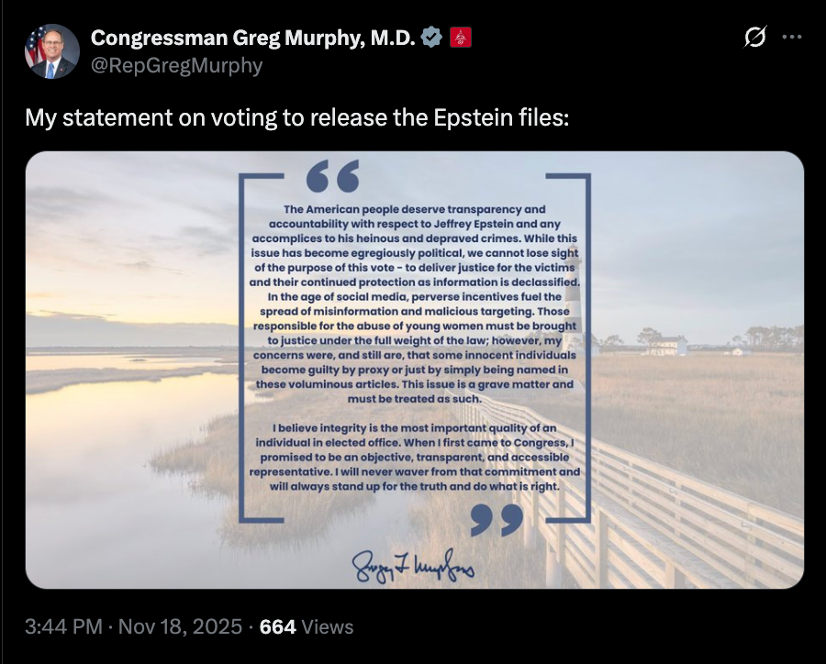
[Twitter, @RepGregMurphy, 11/18/25]
¶ Murphy never signed the discharge petition to release the epstein files that eventually made its way to the house floor
Nancy Mace, Lauren Boebert, And Marjorie Taylor Greene Were The Only Other Republicans To Sign Thomas Massie’s Discharge Petition To Get A House Floor Vote On Releasing The Epstein Files.

[Clerk of the U.S. House of Representatives, Discharge Petition No. 9, 9/2/25]
¶ Murphy never co-sponsored legislation that called for the epstein files to be released
As Of April 22, 2026, Murphy Was Not Listed As A Co-Sponsored On Rep. Thomas Massie’s Legislation That Called To Release The Epstein Files.

[U.S. House of Representatives, H.Res.581, Introduced 7/15/25]
- H.Res.581 Called On The Justice Department To Release All Unclassified Documents That Related To Jeffrey Epstein Or Ghislaine Maxwell. According to Congress.gov, H.Res.581 would, "This resolution provides a special rule for consideration of H.R. 185 and amends that bill to direct the Department of Justice (DOJ) to make publicly available certain records related to Jeffrey Epstein or Ghislaine Maxwell. Under H.R. 185, as amended by the resolution, DOJ must publicly disclose all unclassified records, documents, communications, and investigative materials in its possession that relate to Epstein or Maxwell. The records include unclassified records referring or relating to Epstein's detention and death; flight logs of aircraft owned or used by Epstein; individuals named in connection with Epstein’s criminal activities, civil settlements, or immunity or plea agreements; immunity deals, sealed settlements, or plea bargains of Epstein or his associates; entities with ties to Epstein’s trafficking or financial networks; and internal Department of Justice communications concerning decisions to investigate or charge Epstein or his associates. However, under the amended bill, DOJ may withhold or redact portions of records with written justification that such portions contain (1) victims' personally identifiable information; (2) child sexual abuse materials; (3) images of death, physical abuse, or injury; (4) information which would jeopardize an active federal investigation or prosecution; or (5) classified information. DOJ may not withhold or redact records on the basis of embarrassment, reputational harm, or political sensitivity. Further, within 15 days of completing the required disclosures, DOJ must provide Congress with a report listing all categories of records released and withheld, all redactions made and their legal basis, and all government officials and politically exposed persons named or referenced in the released materials." [U.S. House of Representatives, H.Res.581, Introduced 7/15/25]
¶ Murphy had previously voted to protect the accused pedophiles named within the epstein files
¶ September 2025: Murphy Effectively Voted Against Releasing The Epstein Files
2025: Murphy Effectively Voted Against Releasing The Epstein Files. In September 2025, Murphy voted for, according to Congressional Quarterly, “adoption of the rule [that] […] would consider as adopted a resolution (H Res 668) that would direct the House Oversight and Government Reform Committee to continue its ongoing inquiry into the possible mismanagement of the federal government's investigation of disgraced financier Jeffrey Epstein and his associate Ghislaine Maxwell, the circumstances surrounding Epstein's death in federal custody, sex trafficking rings and potential ethics violations by elected officials. […] It also would table a rule (H Res 598) that would provide for the adoption of a resolution (H Res 589) concerning the release of certain documents related to the Epstein case.” The vote was on the rule. The House agreed to the rule by a vote of 212 to 208. [House Vote 222, 9/3/25; Congressional Quarterly, 9/3/25; Congressional Actions, H.Res. 672]
- Representatives Massie And Khanna Introduced A Discharge Petition To Force A Vote On The Release Of The Files With Four Republicans Signed On To It As Of Mid-September. According to NBC News, “In the House, the ‘discharge petition’ to force a vote on the Massie-Khanna legislation is on track to succeed. It has 216 signatures — including all Democrats and four Republicans — and needs just two more. Those two are expected to arrive this month in the form of a newly elected Democrat in a Virginia special election and another safe blue seat in Arizona that will get a special election in late September. Massie told NBC News on Tuesday that the four Republicans who have signed on are solidly behind the effort and won’t bow to pressure to remove their names. He said other GOP lawmakers have signaled to him they are open to signing the petition but prefer not to get crosswise with Trump or party leaders publicly if their votes aren't needed to pass it. [NBC News, 9/10/25]
¶ July 2025: Murphy Cast The Deciding Vote Against Releasing The Epstein Files
HEADLINE: "House GOP Blocks Second Dem Attempt To Release Epstein Files" [Axios, 7/15/25]
2025: Murphy Voted To Block The Release Of The Epstein Files. In July 2025, Murphy voted for, according to Congressional Quarterly, the “motion to order the previous question on the rule (H Res 580) providing for floor consideration of the fiscal 2026 Defense appropriations bill (HR 4016), the Anti-CBDC Surveillance State Act (HR 1919), the Digital Asset Market Clarity Act (HR 3633) and the Guiding and Establishing National Innovation for U.S. Stablecoins (GENIUS) Act (S 1582).” The vote was on the previous question. The House agreed to the motion by a vote of of 211 to 210. [House Vote 194, 7/15/25; Congressional Quarterly, 7/15/25; Congressional Actions, H. Res. 580]
- The Vote Served As A Referendum With Its Passage Blocking Consideration Of Representative Khanna’s Amendment To Require Release Of The Epstein Files. According to Politico, “Rep. Ro Khanna (D-Calif.) had slightly more success mounting an effort to amend cryptocurrency-related legislation scheduled to hit the House floor later this week to compel the release of Epstein-related files. Democrats forced a Rules Committee vote on whether to allow a floor vote on Khanna’s amendment; Republicans voted it down, though one Rules member in their ranks, Rep. Ralph Norman of South Carolina, crossed party lines. On the floor Tuesday afternoon, House Democrats attempted to cast a procedural vote as a referendum on releasing the so-called Epstein files. Had their effort to vote down the motion succeeded, they said, they would have moved forward with Khanna’s amendment. But the ‘previous question’ vote, which hasn’t been won by the House minority since 1988, prevailed 211-210 on party lines.” [Politico, 7/15/25]
¶ If One “Aye” Vote Had Switched To A “No” Vote In House Vote 194, The Measure Being Considered Would Have Failed Instead Of Passing
The Measure Considered In House Vote 194 Passed With 211 “Ayes” And 210 “Nos,” Which Meant If One Aye Vote Had Switched To A No Vote The Measure Would Have Instead Failed.

[House Vote 194, 7/15/25; Congressional Quarterly, 7/15/25; Congressional Actions, H. Res. 580]